


You don’t have any Active Subscription.
Subscribed with another email? Logout and Login with that one.
Account subscription benefits alongside Premium Stories, Editorials, Opinions and more. Unlock these with Subscription
Additional Subscription Benefits
Need help with your subscription?
The View From India Looking at World Affairs from the Indian perspective.
First Day First Show News and reviews from the world of cinema and streaming.
Today's Cache Your download of the top 5 technology stories of the day.
Science For All The weekly newsletter from science writers takes the jargon out of science and puts the fun in!
Data Point Decoding the headlines with facts, figures, and numbers
THEdge At the cutting edge of education and careers
Health Matters Ramya Kannan writes to you on getting to good health, and staying there
Gender Agenda Stories from beyond the binary.
On Books Books of the week, reviews, excerpts, new titles and features.
Published - August 23, 2026 10:54 am IST - BEIJING
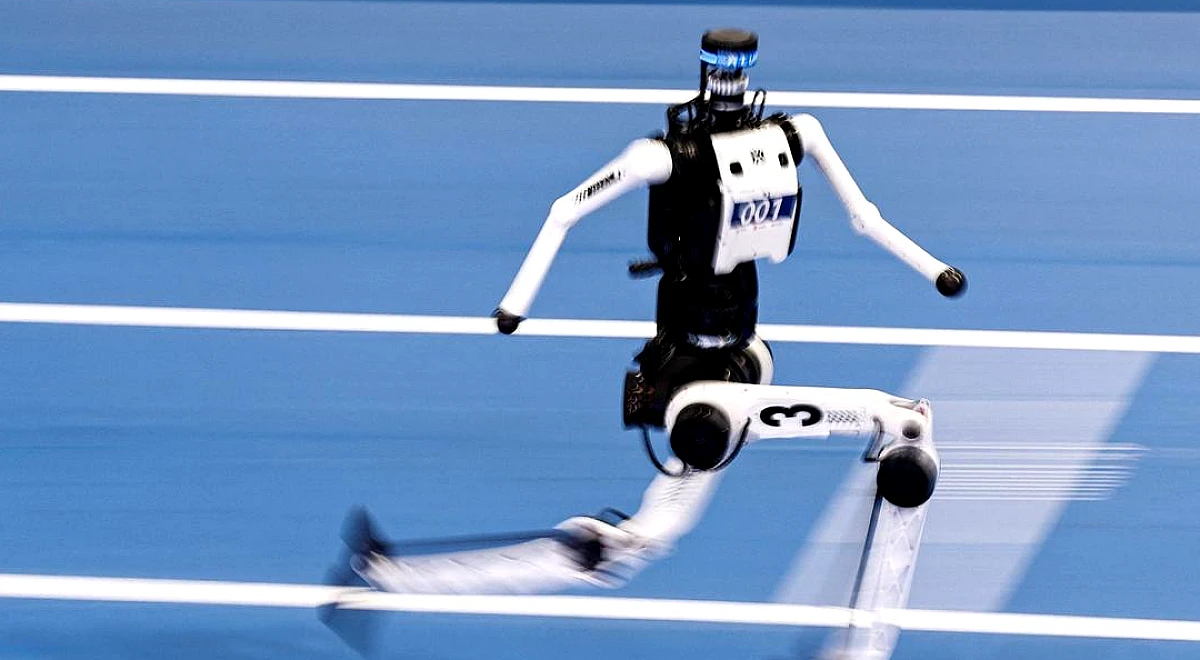
A Tiangong humanoid robot competes during a 100m large-sized group preliminary race, following the opening ceremony of the 2026 World Humanoid Robot Games, at the National Speed Skating Oval, in Beijing, China on August 22, 2026. | Photo Credit:
Chinese humanoid robots broke records set by humans, including beating Usain Bolt’s 100-meter sprint world record, on the opening day of the Olympics-like World Humanoid Robot Games in Beijing on Saturday (August 22, 2026).
More than 2,000 humanoid robots were participating in the event, the organiser said.
The five-day games, now in its second year, are a spectacle demonstrating China’s rapid progress in advanced robotics as the technology race with the U.S. heats up, with 51 events and more than 1,000 competitions taking place including running, table tennis and soccer.
Also Read | Inside the rise of robotics firm Unitree, glimpse into China’s tech ambitions
The games, which are taking place in the National Speed Skating Oval built for the 2022 Winter Olympics, opened the same week as Beijing held the 2026 World Robot Conference, where companies showcased around 3,000 products, including humanoid robots.
China makes the majority of the world’s humanoid robots. The U.S. has stepped up scrutiny of robots from the country.
Last month, the U.S. Federal Communications Commission announced a ban on imports of new foreign-made humanoid robots. The FCC cited national security reasons in a move that targeted China. The Pentagon recently also added Unitree, one of China’s leading humanoid robot makers, to its list of companies that it deemed have ties with the Chinese military. Beijing has hit back at the accusations.
Also Read | Robots race, play football, crash and collapse at China’s ‘robot Olympics’
At Saturday’s (August 22, 2026) opening of the robot games, the organiser and robot makers said that Chinese humanoid robots defeated human world records, as hundreds of humanoid robots marched in formation onto the field in a massive display of synchronized coordination.
At a 100-meter sprint, a humanoid robot achieved a result of 9.39 seconds, beating the human record of 9.58 seconds set by Jamaican athlete Bolt in 2009.
In a standing high jump, a humanoid robot was able to reach 2.88 meters, well above the 0.95 meters best result by a humanoid in last year’s first edition of the games. It surpassed the human high jump record of 2.45 meters set by Cuba’s Javier Sotomayor in 1993.
A Tiangong Ultra humanoid robot demonstrates a 2.88m standing high jump during the opening ceremony for the second World Humanoid Robot Games at the National Speed Skating Oval in Beijing, China, on August 22, 2026. | Photo Credit:
Also Read | Trump administration bans new Chinese humanoid robots, to protect U.S. AI buildout
Both robots were from Beijing-based X-Humanoid.
Before the opening, a humanoid robot from Chinese smartphone company Honor completed a 100-meter sprint in a record of 9.32 seconds during a trial of the games, the company said, at a peak speed of 14.5 meters per second.
Still, experts say humanoid robots are still mostly used for demonstrations, performances and research — at least for now — and it will still take time to achieve mass real-world deployment.
Also Read | Humanoid robots race past humans in Beijing half-marathon, showing rapid advances
Some spectators at the robot games said they were excited about the humanoid robots’ quickly improving abilities.
Humanoid robots are “evolving rapidly,” said Li Yanfeng, an education worker and a Beijing resident.
“At first, I wasn’t very accepting of artificial intelligence. I was even a bit resistant to it, because of the possibility that it might replace or displace humans,” she said. “But now that I see this development is unstoppable, I decided to come and take a look.”
Also Read | Robot dogs and AI drone swarms: How China could use DeepSeek for an era of war
“These sports are perfectly normal for humans, but now robots can do them. I find it amazing,” said Yang Shangzheng, another spectator.
Liu Tao, who was watching the games with his son, said that he was hoping to see “the best robots China currently has to offer.”
This year’s robot games — which the organizer said has 16 countries participating, among them Germany, Japan and the U.S. — also include other events such as weightlifting and tug of war.
Published - August 23, 2026 10:54 am IST
robotics / China / technology (general)
Terms & conditions | Institutional Subscriber
Comments have to be in English, and in full sentences. They cannot be abusive or personal. Please abide by our community guidelines for posting your comments.
We have migrated to a new commenting platform. If you are already a registered user of and logged in, you may continue to engage with our articles. If you do not have an account please register and login to post comments. Users can access their older comments by logging into their accounts on Vuukle.





Comments ()
Be the first to share your perspective on this story!