


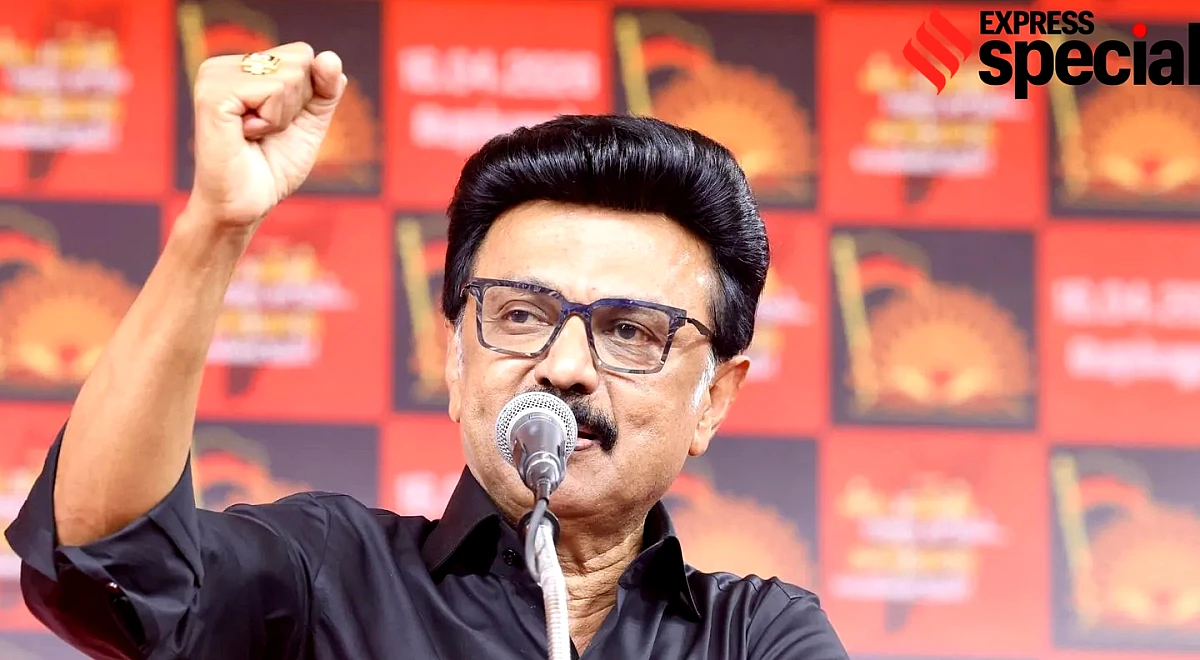
Faced with defeat, more or less every political party undergoes a stage in which the numbers may have been accepted, but a struggle ensues to get to grips with their meaning. Three months after the DMK was routed from power in Tamil Nadu, party president and former Chief Minister M K Stalin, who himself lost his constituency, stood before his party’s executive committee and attempted to explain failure to an organisation accustomed to thinking historically about its own survival.
“There is no victory that we have not seen and there is no defeat that we have not seen,” Stalin told the party’s high-level executive committee, which adopted the proposals to revamp the party organisation. “We have lost only this election. This is not permanent.”
A message meant to reassure the party also contained the central tension that defines the DMK at the moment. While the party has accepted that it lost an election, it is less evident that it has understood the phenomenon that defeated it.
Stalin was unsparing about some of the party’s failures. “First, we must acknowledge our mistakes. We must acknowledge them openly,” he said. A 38-member committee examined the defeat. Tens of thousands of suggestions arrived through a website. Stalin said he had read them. A restructuring committee headed by former minister Thangam Thennarasu considered organisational changes. Then came perhaps his finest metaphor: “A lamp that gives light to an entire town cannot see the darkness beneath itself.”
The darkness, in his diagnosis, included inaccessible office-bearers, fake membership figures, entrenched local hierarchies, and leaders unwilling to let others grow. Stalin proposed age limits and tenures for some positions, genuine membership enrolment, organisational elections and more opportunities for newcomers. These are substantial admissions for a 75-year-old political movement.
Is DMK misreading the symptoms?
But what if the problem is larger than the organisation? The DMK appears, at least from Stalin’s prescription, to be treating an existential shock partly as an organisational malfunction. The district secretary needs reform, membership needs verification, and younger people need promotion. In short, the machinery needs servicing, it believes.
While all of the above may be true, the TVK did not defeat the DMK because it had better district secretaries. Chief Minister C Joseph Vijay arrived through an almost opposite political architecture: fandom, celebrity, digital culture, first-time political workers, exhaustion with the status quo, and voters willing to entrust the state to people without the apprenticeship.
The elections saw voters challenge the political establishment’s assumptions about political legitimacy. Against this backdrop comes Stalin’s continued questioning of the new forces in charge of the state.
“Look at the kind of people who have now come to power,” said the DMK chief. “They have come to power without working for the people, without conducting struggles, without ideology and without an organisational structure.”
In short, he tried to remind his colleagues that their movement possesses something the TVK does not: history.
However, as a senior leader said, that leads to a more pressing question. “If people without sufficient struggle, ideology or organisation defeated a party possessing all three, what exactly did voters choose?” asked the leader. “To say that the TVK lacked the traditional qualifications for power may be perfectly defensible from within our own understanding of politics. But voters were evidently using another definition.”
That, the senior leader said, remains part of the party’s difficulty in coming to terms with the defeat, particularly Stalin’s loss in Kolathur.
“For the DMK, Vijay is not merely an opponent. His victory challenges its most basic belief about politics, that power must be earned through ideology, organisation and years of political work. He won without doing politics in the manner the party believes politics ought to be done,” said a veteran academic from a Dravidian political family.
After losing Tamil Nadu to a party it says does not know how to be a proper political party, the DMK’s immediate solution is to become a better DMK, he said, adding, “It is a little like discovering that the neighbourhood has switched from newspapers to smartphones and responding by improving the newspaper’s distribution network.”
According to some, Stalin deserves credit as parties rarely examine themselves gracefully after getting routed in elections. His criticism of local bosses was unusually specific. The DMK president also appeared to suggest that the disruptive nature of the party in its nascent years — it disrupted the old order through its language, cinema, street politics, platform speakers, rationalism, and social-justice arguments — has morphed into an institution. And now it is facing another political insurgent.
“Institutions, like individuals, can become trapped by the world they already know. The familiar stops appearing as a choice and begins appearing as reality itself,” said the academic.
Yet, Stalin is right that strong organisations survive defeats. The DMK has done so repeatedly and its institutional memory may be its greatest asset as it faces off against the TVK. However, a comeback requires more than remembering how one returned last time.
Stalin told the cadre to begin campaigning in their homes: secure the votes of children, relatives and neighbours before venturing outside. It was practical advice but may also have inadvertently pointed to its problem. “A cadre may be sitting at his dinner table with his family. The child of a lifelong DMK family may admire Periyar, accept social justice, speak the political vocabulary created by the Dravidian movement and still vote for Vijay … That voter cannot necessarily be recovered by a better membership register or a new district secretary,” said the academic.
Half a dozen DMK fellow travellers — former ministers, longtime associates, and a leader who later joined the TVK — whom The Indian Express spoke to emphasised one point repeatedly. The party’s challenge is not simply restructuring itself but understanding why somebody could inherit much of the world the Dravidian movement created and still decide that its principal political custodian no longer deserved his vote.
“Stalin has begun the first task. His speech proves that the DMK knows it must change,” a former minister said.
As Stalin said, a lamp may indeed illuminate an entire town without seeing the darkness beneath itself. But after this election, the DMK must consider another possibility. Perhaps the town itself has changed.
Arun Janardhanan is an experienced and authoritative Tamil Nadu correspondent for Read More
Comments ()
Be the first to share your perspective on this story!