
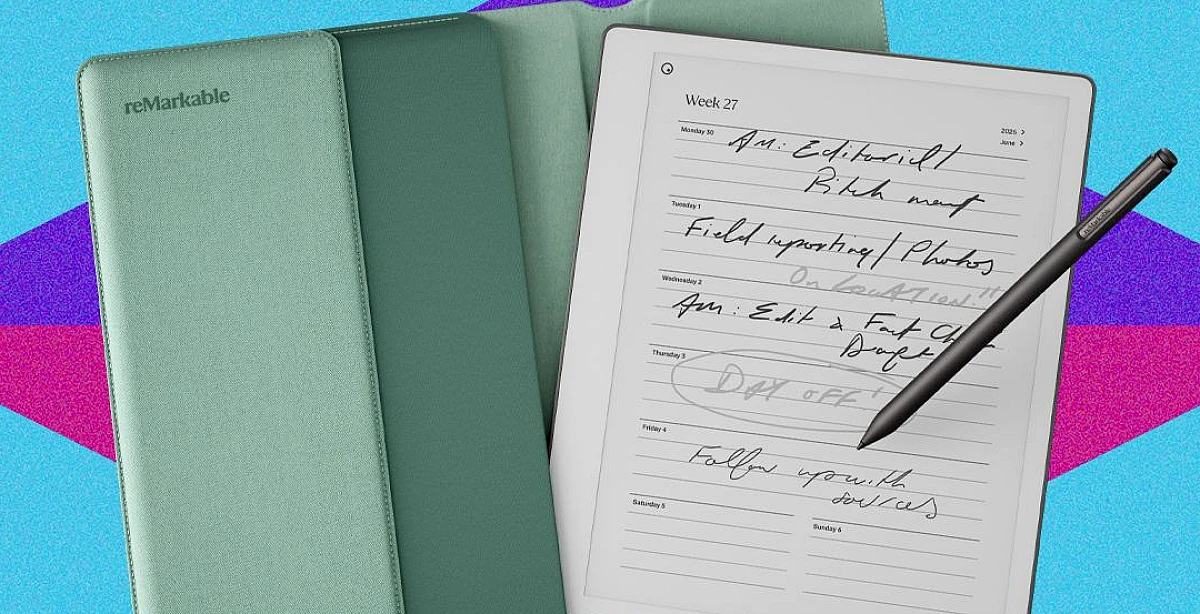
Do you take a lot of notes? Whether it's daily to-do lists, notes for class, or just jotting down thoughts, I've found the best digital notebooks to keep them organized. Sure, you could just open your Notes app, but physically writing something down helps you remember and learn more. Plus, I just love to write things down, and these digital notebooks keep me from burning through paper or losing a great idea I wrote down.
These tablets use E Ink technology to give you a more paper-like experience to write your ideas and notes on. It's easy on the eyes and helps keep you distraction-free as you take your notes like a classic notebook would. As our team's resident obsessive notetaker, I've tried almost every digital notebook on the market to find the best ones worth buying. Whether you want to be able to take detailed notes and access them on your laptop, annotate a book, or have near-never-ending battery life, I've found a digital notebook for you. They're especially great for students who need to do a lot of note-taking and stay engaged without getting distracted by notifications and other apps.
If your notes need an upgrade, I highly recommend giving these a try. If you're looking for a paper companion to stay organized for the school year, don't miss my Paper Planners guide with a brand-new academic favorite.
Updated August 2026: I've added the TCL Note A1 Nxtpaper as a new pick if you don't need an E Ink screen and want more tablet features.
Amazon (Marker Plus Bundle)
The ReMarkable Paper Pro has everything we like about the ReMarkable 2—a matte screen feels like paper, quick and responsive writing experience, and a great battery life—and adds a few cool new features like colorful pen options and a gentle built-in screen light that uses ambient light from the room. It's got an 10.8-inch screen, making it an extra inch and a half bigger than the ReMarkable 2. It's especially handy if you're taking notes or writing down ideas somewhere a little dark, like a dimmed classroom or on a late flight. Like the ReMarkable 2, it's easy to organize your notes in various ways, from different notebooks to tags and folders. It's easy to access notes off the device, too, especially if you have ReMarkable's Connect subscription ($3 per month) for unlimited cloud storage. The stylus charges on the device, too.
There are many ways to organize your work into different notebooks or quick sheets, and you can sort them with tags and folders. You also upload PDFs and ebooks to the slate via the company's app or website, and ReMarkable has a Chrome extension that lets you send any webpage to read on the tablet, and a desktop app that lets you upload PDFs, like a blank Dungeons & Dragons character sheet to fill in on your next game night. You can integrate your notes into Google Drive, Dropbox, or Microsoft OneDrive, though you'll want the Connect subscription for unlimited cloud storage. You can also join the beta program for ReMarkable Methods as a Connect subscriber, which introduces a new library of templates and workbooks you can add to your ReMarkable device. There's also a beta program (that again you'll need to be a subscriber to join) for the new Handwriting Search, which will scan your notes to learn what you've written and allow you to search for it.
The Paper Pro does have its own set of accessories, including covers ($179) to protect it and a keyboard folio ($229) if you want to type with it, since it's a different size than the ReMarkable 2. It has its own set of styluses as well, the Marker and Marker Plus—the Marker Plus is a $50 upgrade, but I find the eraser to be well worth it.
Is the second-generation Amazon Kindle Scribe the best digital notebook? No. It's a bit of a hybrid. I'd describe it as an extra-large Kindle that happens to have some digital notebook abilities. But time and time again, I find myself reaching for my Kindle over the other digital notebooks in my house. I'm a big reader, and a Kindle user at that, so having one device that already has all my books that can also serve as my personal doodle pad has been really convenient. It also helps that it has the best battery life of up to 12 weeks, so I almost never need to charge it before using it.
ReMarkable and Supernote have more templates and compatibility, and Kobo's devices let you actually write notes on the book. Kindle only lets you write on Post-It-like pop-ups, called Active Canvas, and an expanded sidebar margin that can pop up and take up a third of the page for you to write on. If you're looking to actually annotate a book, the Kobo Libra (more on that below) is a better choice. Both the Kobo Elipsa and Libra give you more freedom to actually write on book pages, and the Libra gives you the option of color.
The Scribe does now come with new generative AI features (Summarization and Refined Writing), but they’re subtle. You're able to sync the notebooks on your Scribe to the Kindle app, but these don't sync as seamlessly as the ReMarkable app does. And yet, since I'm already a Kindle user, I find myself always grabbing this notebook to read my latest library book or jot down ideas on a notepad. It's serving me well for my minimalist needs—I use my notebook for doodling ideas and writing lists rather than taking notes for class or uploading PDFs to edit—but our recommendations above are more powerful with better accessories.
If you like the price of this model but want more AI features (a pass for me, personally) and the ability to connect to Google Drive and Microsoft OneDrive, and don't mind losing out on the front light, check out my notes below on the Kindle Scribe Without Front Light ($430). You can also spend a little more on the third-gen Kindle Scribe ($500) to get a front light, or even more on the Kindle Scribe Colorsoft ($630) to get a color screen. I still prefer the older second-gen Kindle Scribe, but you can read all about the newer models below.
Kobo makes some of our favorite e-readers, and the Kobo Libra Colour takes its e-reader software and not only adds digital notebooks, but color annotating, too. You can write in the margins and underline your favorite quotes using eight different colors (plus black and gray, giving you 10 choices total), and you can hold down the button on the Stylus 2 ($70) to enter highlight mode. You can only highlight books in yellow, but there are four highlighter colors in notebook mode. The Stylus 2 also has an eraser on the back that works as an object eraser, so one tap to the highlighted area or on-page doodle and the whole thing will vanish from your book's page.
The Libra also has a separate notebook section, where you can create different digital notebook pages. You can choose from a variety of layouts for each page (click the three dots and choose “change page background”) in a notebook, plus three different pen styles, a highlighter, and a paintbrush to use with the eight colors and two neutrals in the Libra's digital palette. It is a small size, so good for taking quick notes but not ideal for, say, writing down everything from an intense lecture. My handwriting also didn't appear as clearly as it did on ReMarkable and Scribe devices. But if you're more of a quick-list or idea kind of person and mainly want to annotate your e-books with color, the Kobo Libra Colour will be perfect for you. It recently rose in price, from $230 to $260, so I'd wait to buy it on sale rather than pay the new MSRP.
★ Larger, but no color: We previously recommended the Kobo Elipsa 2E ($400) for readers, and while it's still a great device, I think it's just a little too large for frequent readers (I much prefer the smaller Libra to bring books with me on the go), and missing out on color is a huge bummer. But I prefer both Kobos to the Kindle Scribe for annotating while I read, and the Elipsa and Scribe are similar sizes.
ReMarkable (Paper Pure Bundle)
This is the same price as the second-generation Kindle Scribe I adore, but with more powerful digital notebook tools instead of a focus on reading. If you're looking for a great digital notebook without spending the better part of a grand, ReMarkable's new Paper Pure is its new basic digital notebook with a black-and-white screen, a lightweight feel, and a great writing experience that is one of the closest things you'll get to writing on actual paper.
The Paper Pure replaces the ReMarkable 2 from 2020 and offers noticeable upgrades, including better contrast and a crisper white screen, but it still skips features like a front light and color, which would make it cost more. There's a protective folio you can add that comes in a couple of fun colors, but there's no keyboard folio for this device (unlike the ReMarkable 2 and Paper Pro), so you can't transform it into a makeshift e-paper laptop for faster note-taking or writing. Still, it's an all-around great device for a great price. The Paper Pure just launched in May and begins shipping in June.
Amazon (Marker Plus Bundle)
ReMarkable (with Marker Plus)
The ReMarkable Paper Pro Move is similar in size to a reporter's notebook, which turns out to be a pretty great size for most daily tasks. There's room for a multilevel to-do list and brainstorming, and it's a nice, small size with just a 7.3-inch screen. There are other small options on the market, but this is the only one designed like a long notebook rather than a square, e-reader-like design. I like this size a lot better to layer on top of a paper planner or slip into a bag.
It can do everything the larger Paper Pro can, and honestly feels like you sliced off a bottom third of the device and kept using it. You'll still get a great writing experience with a matte screen and paper-like feel, and my handwriting looked better than ever on both the regular and Move version of the Paper Pro. The Move does have its own smaller page size that it'll create with new notebooks. Notebooks made on the larger ReMarkable devices will still work on this one, and vice versa, though you may notice some gray bars on the sides or tops where the sizing doesn't perfectly match. If you turn the Move to landscape mode, though, it becomes the same aspect ratio as the larger Paper Pro, so it's a good way to review larger notebooks and documents.
It's a great size and option if you're more of a list writer than a detailed notetaker and don't want to use it to type, since it doesn't have a typing attachment like the larger ReMarkable devices. It does have a convert-to-type button, though, if you want to turn your notes into a typed format.
Supernote (with Standard Pen)
The Supernote A5 X2 Manta is the second generation of Supernote's A5 digital notebook, and it's a great option with new upgrades like a dual slider bar, upgraded RAM, and FeelWrite 2 film covering the screen to give it a feeling similar to paper. You can also expand the storage with a microSD chip, and there's a modular design under the hood so that you can easily upgrade the motherboard or put in a new battery.
The software is easy to use and has a design similar to ReMarkable’s. There’s also a cloud website and app you can use to send PDFs to the digital notebook to edit. You can also integrate it with apps like Google Drive and Dropbox. You can also add on the app Atelier to get a digital sketchbook option (though it's only in shades of grayscale), and you can choose a document type that will convert your handwriting into a typed document.
But where Supernote really shines is that it has, in my opinion, the best pens in the game. Right now, it has a special, clear LAMY Safari Vista EMR ($99) pen that looks so realistic, I keep grabbing it to write in my paper planner, and it feels great to write with. The Heart of Metal ($83) pen is also a fantastic pen, with a little more weight to it, thanks to the metal body. Both pens are sold out right now, but you can get notified when they're back in stock. Ultimately, if you're a bit of a pen and stationery nerd (and don't need a keyboard attachment, which Supernote doesn't offer), then you'll get your heart's fill with Supernote's pen lineup paired with its great digital notebook.
What if you could have 80 percent of what's great about an E Ink screen and still watch videos and use your tablet like, well, a tablet? That's the premise behind TCL's Note A1 Nxtpaper, which wants to be the best of both worlds. The screen is not E Ink, and the writing experience is correspondingly not E Ink–good here, but it's good enough for many, and the fact that when I'm done taking notes I can go stream a video makes the Note A1 more versatile than most tablets on this page. The Note A1 includes a very nice reversible pen (you can erase with the top) and a keyboard. The unnecessarily complex keyboard case requires a deep understanding of origami to use properly, but it protects the device, and the keyboard is nice to type on (it's included in the price).
The custom user interface that TCL has built makes this device decidedly note-focused. The home screen consists of a small to-do list, a clipboard shelf, and then a list of all your notes. Click on a note with the pen, and it will open in edit mode with a configuration toolbar shown across the top. Here you can set up pen type, color, line thickness, and all the other tools you'd want to use to write or draw. I found the editing interface just about perfect in the sense that it balances keeping it simple but still gives you access to the controls you actually need. There are, however, some quirks here. For example, you can't easily switch from reading a note to editing. For the most part, though, the UI works well for the intended purpose (primarily, taking notes). There are some nice AI-driven features here to help with note-taking, including automated meeting summaries, audio-to-text transcription, and handwriting-to-text conversion (also, equations can be converted from handwritten to typed). Underneath its custom UI, this is an Android tablet with the Google Play Store at your disposal, so you can run all the usual apps. —Scott Gilbertson
Neo Smartpen M1+ for $129: If you don't want an entire tablet to write your digitized notes on, you can get a smart pen to use on regular paper that will log your notes into its companion app. The Neo Smartpen M1+ was the thinnest and lightest smart pen former WIRED reviewer Medea Giordiano tried, and she easily used it with notebooks and planners alike. You'll pair it with the Neo Studio app, which has a notebook system that's easy to navigate and organize your notes.
Moleskine Smart Writing Set for $225: Moleskine is already known for its notebooks, and the brand has a smart version now, too. Our team previously tested a version in 2018 that only cost $149, but the current version that's $224 is next on my list to test. The set comes with a notebook and pen that will pair with the Moleskine Notes app to show you your notes.
The 3rd Gen Kindle Scribe (left) and the Kindle Scribe Colorsoft.
Kindle Scribe Colorsoft ($630) and Kindle Scribe (3rd Gen) ($500) and Kindle Scribe Without Front Light ($430): The new versions of the Kindle Scribe are still solid all-around devices that have a good mix of e-reader and digital notebook features, but I still prefer the older model's price point. While the new Scribe Colorsoft is a nice option if you want color, I think both are too expensive for what they are. The price comes from all the AI features packed into the device, plus connectivity to services like Google and Microsoft, but it still isn't as powerful as a ReMarkable or Supernote if you want better tools. My picks above are a better price for similar features, though the Scribe does have the most impressive battery life of any digital notebook device I've tried (and that's still true for the older model that I recommend above, too, so you don't need the newest model for the best battery life).
Boox Note Air4 C for $470: If you're looking for something a little more powerful than just taking notes and annotating, but still want the E Ink screen experience, then a Boox device is what you need. The Boox Note Air4 C has an e-paper screen and is primarily described as an “e-paper notebook,” but runs on Android 13 and has access to the Google Play Store, giving it more of a tablet feel that happens to have a colorful e-paper screen instead of your usual brightly lit iPad or Android tablet. You're able to easily access the web (called NeoBrowser) right from the Boox homepage, which usually takes several steps and is incredibly slow on a true digital notebook. You'll also access apps that look like a tablet, including an image gallery, calendar, music player, and tools like a clock, recorder, and calculator. It was a pick in this guide, but it's now out of stock for US warehouses (you can still order from the Hong Kong warehouse, but you might have to pay extra tariffs and fees), and there's a new version out, the Note Air5 ($530).
Montblanc Digital Paper for $935: Yes, that Montblanc, the one with the famous pens, now has a digital notebook of its own. It's no surprise that I'd call its digital pen one of the best. It's got a super-lightweight feel while sporting three different buttons, two of which you can customize. (There's no eraser, but I'll give it up for that end of the pen to instead be a home button). I really like this device overall, but it's pricey for what you get—aside from the customizable pen buttons, there's not much to differentiate it from my top picks.
Neo Smartpen Dimo for $59: This is the cheapest smart pen option and uses replaceable batteries. It isn't compatible with Google Calendar, iCal, or Outlook like our other picks.
ReMarkable 2 for $419 (Refurbished): This is the older ReMarkable digital notebook from 2020, and it's still a great device with a great range of accessories—while they're still available, that is. This device is only available refurbished or secondhand after getting essentially replaced earlier this year with the ReMarkable Paper Pure.
Rocketbook Fusion Plus for $30: If you really prefer the paper experience and don't want something you need to charge, then Rocketbook is for you. Rocketbook makes several reusable notebooks, planners, and accessories like index cards and sticky notes. I like the Rocketbook Fusion Plus since it comes with a ton of different template styles, from your classic monthly and weekly pages to project management layouts and meeting notes, making it feel closer to the variety a digital notebook can offer you. Take notes with an erasable Pilot Frixion Pen (one comes with whichever item you buy), scan photos of the pages into the Rocketbook app, and erase the whole thing with the damp microfiber cloth (also included). The app is designed to keep everything organized and easily send things off to Google Drive, Slack, Trello, OneNote, and a handful of other options.
Supernote A6 X2 Nomad for $394 (with Standard Pen): This is a smaller version of the Supernote A5 X2 Manta, measuring almost 6 inches on one side and 7.5 inches on the other. Supernote designed it with travel in mind, but I find it to be a great size for a daily digital to-do list or writing down quick notes from a meeting. It's too small for anything major, but if you're looking for something compact, this is a good option with Supernote's software (and with the same fantastic pens!). Like the Manta above, this model rose in price due to the tariffs, though it only went up $30.
Do You Need a Digital Note-Taking Device?
The short answer is no. These devices are expensive, usually costing several hundred dollars when a simple notebook and pen costs a few bucks. But if you like the physical act of writing but need to have digital copies, they're worth considering.
E Ink notebooks are easier on the eyes and feel closer to paper than a glass-screened tablet. But in some cases, you might spend less getting an iPad and an Apple Pencil (and a keyboard if you also want to type sometimes). You can also do more on them thanks to the thousands of apps in the App Store. An iPad is pretty intuitive if you're familiar with the Apple ecosystem (though both ReMarkable and Supernote's ecosystems are also very intuitive). Former WIRED reviewer Jaina Grey recommended using her 11-inch iPad Pro with the GoodNotes and Notability apps for her writing, but there are other models that should work fine, including our top pick, the 2025 iPad. Check out our guide to the Best iPads for more advice on which to buy.
I also have an iPad, and I'll say the upside of a digital notebook is that the battery tends to last longer, especially if you're the type to use it for a day or two and then forget about it for a few days. My trusty Kindle Scribe usually manages to have plenty of battery available for whenever I feel the note-taking itch, even if it's been a week or two since I last touched it.
Why Are Digital Notebooks so Expensive?
Just because these devices look like paper doesn't mean they're as cheap to make as a sheet of paper. Like any tablet or smartphone, these devices are packed with features, a special ecosystem, and the E Ink technology is no small feat to perfect, along with a sensation similar to writing on paper. It's an impressive piece of technology.
Prices haven't gotten cheaper for this category in the wake of tariffs' causing technology prices to rise. ReMarkable recently raised the price of our top pick, the ReMarkable Paper Pro. Another favorite of ours from Supernote has gone up a little less than $50, and Kobo also slightly raised its prices, though the $10 increase is pretty minor compared to other increases we’ve seen. We'll continue to monitor prices and flag if more price changes are to come.
Power up with unlimited access to WIRED. Get best-in-class reporting and exclusive subscriber content that's too important to ignore. Subscribe Today.
AT&T Top Deals: Wireless, Internet, Bundles and More!
Best Verizon Smartphone Deals
10% Off Canon Promo Code + Up to 30% Off
$20 Off $100+ with VistaPrint Coupon
Save With a Peacock Promo Code: 3 Months Free
10% Off Exclusive Squarespace Promo Code 2026


Comments ()
Be the first to share your perspective on this story!