


You don’t have any Active Subscription.
Subscribed with another email? Logout and Login with that one.
Account subscription benefits alongside Premium Stories, Editorials, Opinions and more. Unlock these with Subscription
Additional Subscription Benefits
Need help with your subscription?
The View From India Looking at World Affairs from the Indian perspective.
First Day First Show News and reviews from the world of cinema and streaming.
Today's Cache Your download of the top 5 technology stories of the day.
Science For All The weekly newsletter from science writers takes the jargon out of science and puts the fun in!
Data Point Decoding the headlines with facts, figures, and numbers
THEdge At the cutting edge of education and careers
Health Matters Ramya Kannan writes to you on getting to good health, and staying there
Gender Agenda Stories from beyond the binary.
On Books Books of the week, reviews, excerpts, new titles and features.
Updated - August 23, 2026 08:28 am IST
Decades of improper industrial waste management have contaminated groundwater with toxic hexavalent chromium across parts of three districts of Uttar Pradesh, exposing villagers to unsafe water and serious health risks.
Groundwater from handpumps glows bright yellow in different villages of these districts — a telltale sign of toxic hexavalent chromium contamination. Patches of yellow-green earth can also be seen in villages across these districts, revealing the illegal dumps and toxicity hiding beneath the surface.
The dumping started from 1976, as per the National Green Tribunal (NGT). But it was scattered across different districts at different points of time.
The earliest and largest chromium dump came up around 1976 in Rania, Kanpur Dehat, as per NGT reports. There were 62,225 metric tonnes of chromium waste dumped there. It was removed only about a year ago, following NGT orders and missed deadlines. There is an NGT direction to erect a boundary wall around it to minimise the dust from flying out, but the hazards remain.
Over the last five years, the government collected blood samples of people living in the affected areas. It was found that 73%-96% of the samples had levels of hexavalent chromium above safe limits, according to a 2025 government report. But despite years of complaints and legal intervention, the government’s efforts to identify contaminated areas, provide safe drinking water and healthcare, and clean up toxic waste remain slow and inadequate.
Sadly, many villages with contaminated groundwater or chemical dumps are not even part of the State government’s list of identified chromium-affected areas, indicating that the actual affected area is even larger than what the government has accepted so far, and thousands more people could be at risk.
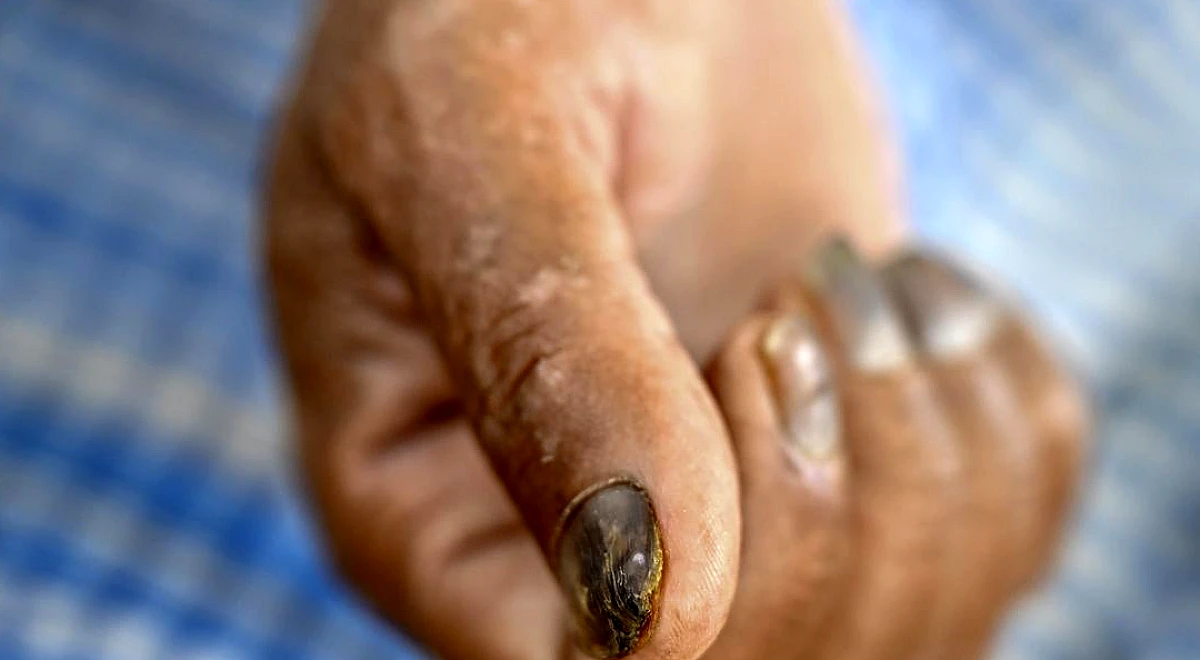
Corroded health: A villager shows his damaged nails, attributing it to heavy metal contamination in groundwater.
Stagnant hazard: Yellowish-green water in a trough near Chhiwali village in Uttar Pradesh’s Fatehpur district.
Neighbourhood watch: A warning sign on toxic waste pileup painted on a wall near Asifpur-Abhaypur village in Fatehpur.
A trail of slime: Chemical sludge seen at an open dump in Fatehpur district. Dumping of hazardous basic chromium sulphate over the years has eroded soil cover in many areas.
Sad plight: A woman seen using a handpump to draw what seems to be water loaded with highly toxic hexavalent chromium at Shivnathpura village in Akbarpur tehsil of Kanpur Dehat district.
Deep rot: Yellowish marks representing heavy metal contamination seen beneath the road surface near a bridge near Chhiwali village at Fatehpur district.
Lethal legacy: The site of one of the oldest and largest chromium dumps at Rania in Kanpur Dehat district. The surface discolouration bears witness to the chromium waste previously here.
Growing risk: The Ganga flows not very far from the villages that are suering from chromium contamination. Many villages with contaminated groundwater or chemical dumps are not even part of the State government’s list of aected areas.
Lurking beneath: A view of a well dumped with waste. Despite years of complaints and legal intervention, the government’s efforts to identify contaminated areas remain inadequate.
Tainted tap: Discoloured water from a handpump near Chhiwali village in Fatehpur district. According to a 2025 government report, 73% to 96% of blood samples from villagers showed high chromium levels.
Published - August 23, 2026 08:24 am IST
Uttar Pradesh / photography
Terms & conditions | Institutional Subscriber
Comments have to be in English, and in full sentences. They cannot be abusive or personal. Please abide by our community guidelines for posting your comments.
We have migrated to a new commenting platform. If you are already a registered user of and logged in, you may continue to engage with our articles. If you do not have an account please register and login to post comments. Users can access their older comments by logging into their accounts on Vuukle.
Comments ()
Be the first to share your perspective on this story!