


Got Question about the News?
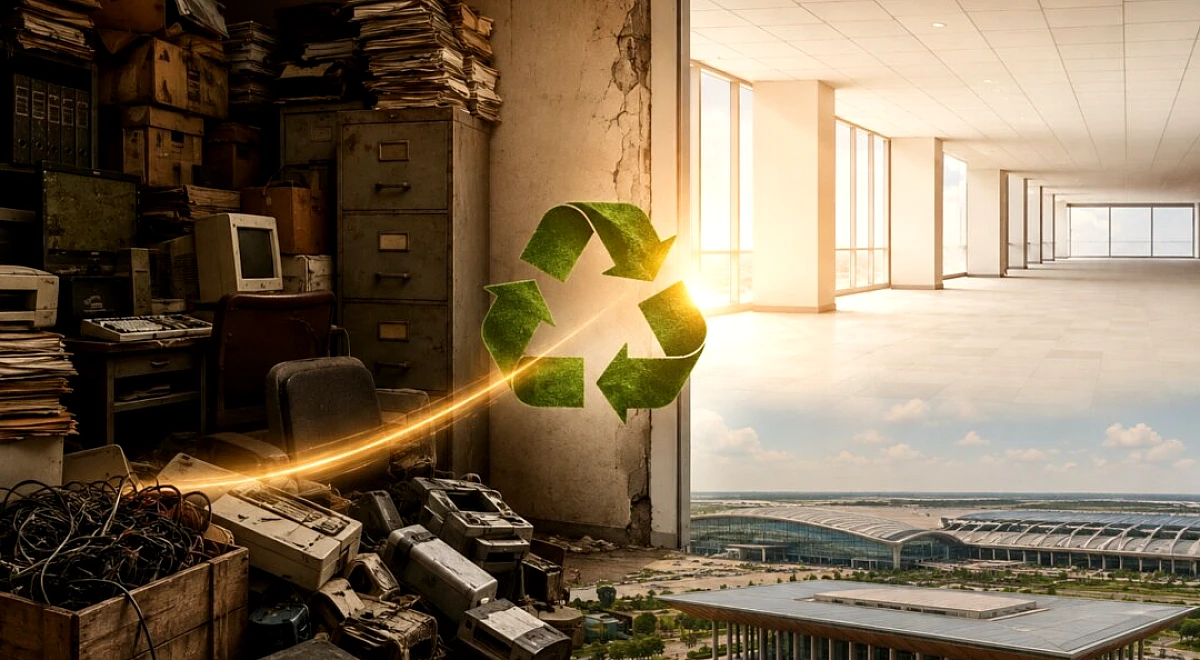
What happens when the government starts looking at its junk as an asset? Over the past six years, old files, obsolete equipment, discarded machinery and other scrap lying across government offices have been systematically cleared, generating Rs 6,000 crore in revenue and freeing up 1,233 lakh square feet of space.
The scale of the exercise is difficult to visualise until the numbers are put into perspective. 1,233 lakh square feet is 12.33 crore square feet. That is roughly the equivalent of 29 Bharat Mandapams or around 21 Delhi Airport Terminal 3s in terms of built-up space.
In other words, the government has cleared enough space to fit the equivalent of dozens of some of Delhi’s most recognisable large public buildings.
And, there is a financial story running alongside the clean-up.
The Centre has earned Rs 6,000 crore by selling the scrap cleared during the exercise over the last six years. What might ordinarily have been dismissed as unwanted government material has instead become a sizeable source of revenue.
To put Rs 6,000 crore in another context, it is nearly 30 per cent of the Rs 20,193-crore outlay for the expanded Gaganyaan programme. Rs 6,000 crore is roughly the annual budget of a substantial standalone government department like the Ministry of Ayush, generated simply by disposing of obsolete government material.
What was taking up all this space? Government offices and establishments accumulate material over decades – broken or obsolete furniture, old machinery, vehicles, electronic equipment, files and other items that are no longer required.
The problem is familiar: once something enters a government store room, yard or office compound, it can sometimes stay there for years.
The clean-up drive has sought to change that.
Departments have been asked to identify material that has outlived its utility, dispose of it through the prescribed process and, in the process, reclaim valuable government space.
The result is a number that is hard to ignore: 12.33 crore square feet cleared.
There are two outcomes here – one that shows up in the government’s accounts and another that shows up on the ground – Rs 6,000 crore came in, and 12.33 crore square feet of space was freed.
That makes this more than a story about selling scrap. It is a story about the value hidden in government clutter, material that occupied space for years but, once cleared, could be converted into both revenue and usable real estate.
Six years of cleaning out government premises has produced an unusual statistic: thousands of crores recovered from what was once considered junk, while enough space was cleared to equal roughly 29 Bharat Mandapams.
Comments ()
Be the first to share your perspective on this story!