

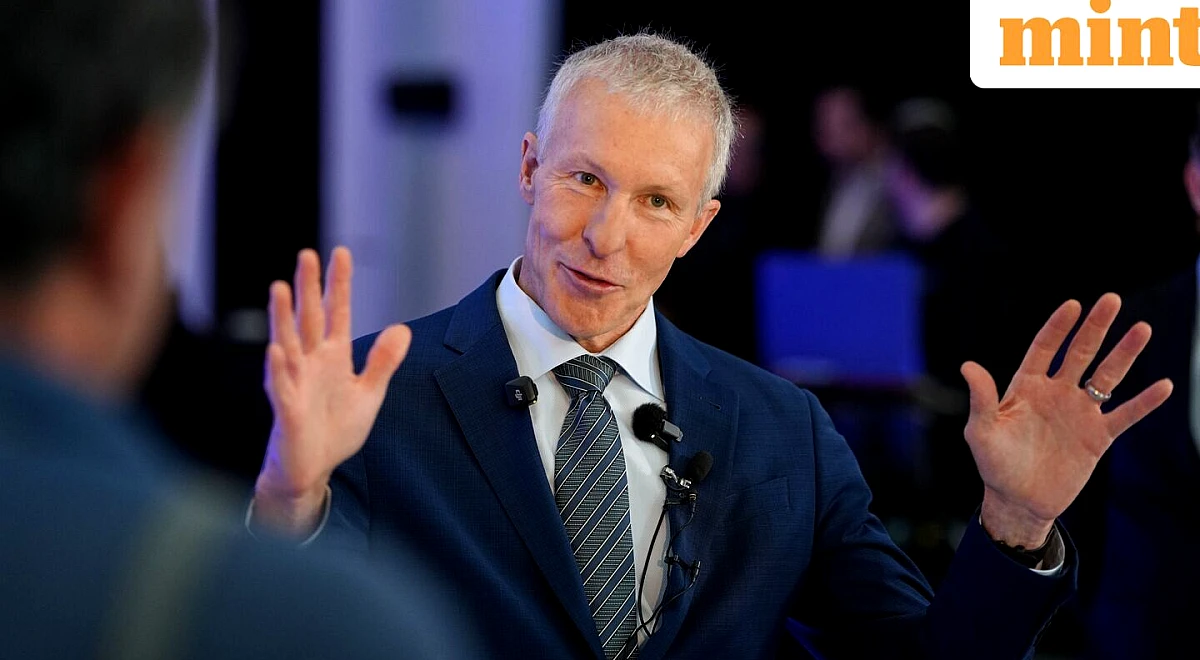
United Airlines chief executive Scott Kirby is charting an ambitious next phase for the carrier, spanning a larger footprint at New York's John F. Kennedy International Airport, further international expansion, premium cabins and artificial intelligence, while keeping the door open to major airline mergers.
The strategy comes as US airlines contend with rising costs, limited airport capacity and growing demand for premium travel. United is also preparing for the delayed arrival of Boeing's 737 Max 10, leaving it with hundreds of premium seats originally designed for the aircraft.
United has hundreds of lie-flat seats sitting in storage after delays pushed back the certification and delivery of the Boeing 737 Max 10. The aircraft was originally expected to enter service in 2020, but United now expects its first Max 10s in summer 2027.
United Airline has 167 Max 10 aircraft on order.
“We got a bunch of lie-flat seats that we don’t know what to do with,” Kirby told CNBC. “They don’t fit on other airplanes.”
United has already adapted to the delays by upgrading a group of Airbus A321neo aircraft with 20 Polaris suites, premium economy seats and other redesigned interiors. The subfleet, called the “Coastliner”, will be used on transcontinental routes.
Kirby also wants United to expand at JFK Airport, where the airline plans to return through a partnership with JetBlue Airways as early as next year.
United is exploring ways to acquire slots from carriers that are not operating profitable routes from the airport.
“We got a bunch of irons in the fire to try to find ways to do it,” Kirby told CNBC in an interview.
The airline already leads US carriers in international flying and is preparing to announce additional overseas routes. Its international network has expanded in recent years to destinations such as Ulaanbaatar in Mongolia and Bilbao in Spain.
Kirby also wants United to strengthen its presence in South America and the southeastern US, where the airline lacks a strong hub.
“Those are two places that are holes for United that are hard to fix on a stand-alone basis,” CNBC quoted Scott Kirby.
Scott Kirby identified Miami International Airport as the best location for serving South America. American Airlines held more than 60 per cent of passenger enplanements at Miami in fiscal 2025.
Scott Kirby has explored potential combinations with Delta Air Lines and American Airlines as he looks for ways to expand United's scale. Both approaches have faced resistance.
People familiar with the matter told CNBC that Delta rejected an approach from United, while American publicly rejected a merger proposal this year.
Kirby said United is not interested in acquiring a smaller airline such as JetBlue.
“Everything I say would require a willing partner,” he said.
American chief executive Robert Isom has also dismissed the prospect of a deal, saying the company focuses on opportunities that have a realistic chance of happening, according to CN.
Kirby, however, argues that concerns over airline consolidation underestimate the differences between major carriers, including their networks and products.
Artificial intelligence is another part of Kirby's plans. He expects AI tools to make travel easier for customers and employees while improving reliability, particularly when airlines face weather disruptions, airport constraints and mechanical problems.
United is also continuing to invest in premium seating as travellers show greater willingness to pay for higher-end cabins.
Operational reliability remains a challenge. In the first half of the year, United ranked behind Delta and Alaska Airlines for on-time arrivals, according to the US Transportation Department.
Kirby, who became United CEO in 2020 after joining the airline in 2016, said his longer-term focus is building a business that can withstand future disruptions.
“Our employees often ask me like, ‘What keeps me awake at night,’ and I tell them, ‘nothing,’” he said. “My job is to set the company up so none of you ever have to have a sleepless night worrying about your jobs.”
His transformation from American's former president to United's chief executive has also shaped his competitive approach. American fired Kirby in 2016, and United announced his appointment almost immediately afterwards.
“I joke that most people take a few weeks, a couple months between jobs. I took 60 seconds,” Kirby said.
A decade later, Kirby is pursuing a strategy that extends beyond competing for passengers. United is seeking more airport capacity, new international markets, premium revenue and technology investments while positioning itself for a rapidly changing US airline industry.
Sayantani Biswas is an assistant editor at Livemint with seven years of experience covering geopolitics, foreign policy, international relations and global power dynamics. She reports on Indian and international politics, including elections worldwide, and specialises in historically grounded analysis of contemporary conflicts and state decisions. She joined Mint in 2021, after covering politics at publications including The Telegraph.
She holds an MPhil in Comparative Literature from Jadavpur University (2019), with a specialisation in postcolonial Latin American literature. Her research examined economic nationalism through Eduardo Galeano’s Open Veins of Latin America. She also writes on political language, cultural memory and the long shadows of conflict.
Biswas grew up in Durgapur, an industrial town in West Bengal shaped by migration, which drew families from across India to the Durgapur Steel Plant. As the only child in a joint family, she spent years listening—almost obsessively—to her grandparents’ testimonies of struggle, fear and loss as they fled Bangladesh during the Partition of 1947. This formative exposure to lived historical memory later converged with her training in Comparative Literature, equipping her to analyse socio-economic structures and their reverberations.
Outside the newsroom, she gravitates towards cultural history and critical theory, returning often to texts such as Paulo Freire’s Pedagogy of the Oppressed. As a journalist, she is committed to accuracy, intellectual rigour and fairness, and believes political reporting demands not only clarity and speed, but historical depth, contextual precision, and a disciplined resistance to spectacle.
Download the Mint app and read premium stories
Log in to our website to save your bookmarks. It'll just take a moment.
Oops! Looks like you have exceeded the limit to bookmark the image. Remove some to bookmark this image.



Comments ()
Be the first to share your perspective on this story!