


Preliminary Examination: Current events of national and international importance.
Mains Examination: General Studies II: India and its Neighborhood- Relations.
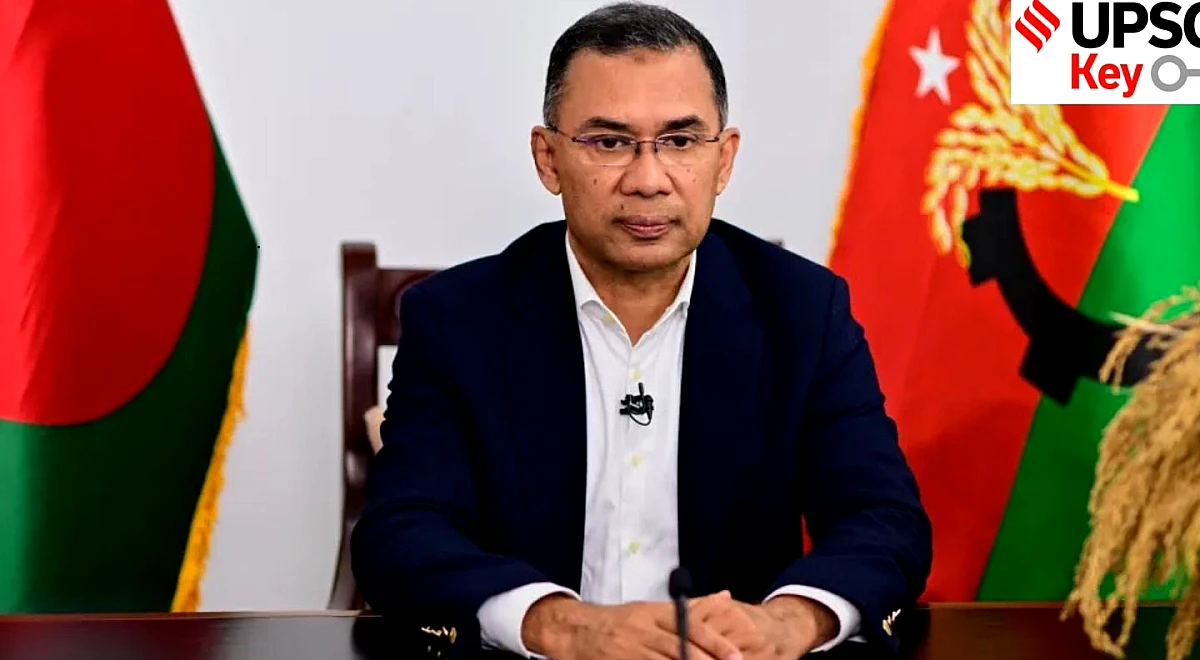
What’s the ongoing story: There were red faces in New Delhi Friday after Rashtrapati Bhavan announced the cancellation of Saturday’s Change of Guard ceremony “due to the full rehearsal for the ceremonial welcome” of Bangladesh Prime Minister Tarique Rahman, and then withdrew the communique an hour later.
— Locate Bangladesh on the map. Which Indian states share a land boundary with Bangladesh?
— Which countries share a land boundary with Bangladesh?
— How does Bangladesh’s geographical location make it strategically important for India?
— India and Bangladesh share nearly 54 transboundary rivers. What are some of the most important ones, and which river-water agreements govern them?
— What is the significance of the Ganga Water Treaty (1996) for India–Bangladesh relations? When is it due for renewal?
—How did the 2024 political transition in Bangladesh alter the dynamics of India-Bangladesh relations?
— What is the difference between extradition, deportation and asylum?
— What is the India-Bangladesh Extradition Treaty (2013)? Under what circumstances can extradition be refused under such a treaty?
— How can the issue of Sheikh Hasina’s extradition affect the broader India-Bangladesh relationship?
— The Ministry of External Affairs, which usually announces the visits of heads of state and dignitaries in coordination with the governments concerned, said it had “nothing to say right now” on Rahman’s visit. Dhaka too did not confirm a date for the start of the visit.
— The announcement and its retraction by Rashtrapati Bhavan added to the uncertainty over Rahman’s visit. New Delhi has invited the Bangladesh Prime Minister and the two sides have been in touch to work out suitable dates.
— Ties between the two countries, severely strained following the August 2024 ouster of Prime Minister Sheikh Hasina who sought refuge in India, had been looking up after Rahman took charge of Bangladesh in February this year.
— But Hasina’s public interaction in New Delhi via an audio link on August 5 — it marked two years of her ouster — angered Dhaka which has been seeking her extradition to Bangladesh where she faces a death sentence. It also cast a shadow over Rahman’s visit to India.
— Several issues remain between the two countries. First, the renewal of the 1996 Ganges Water Treaty, about which Bihar and West Bengal have reservations. Second, the agreement on Teesta water-sharing. Third, the formal extradition of Sheikh Hasina. Fourth, normalising cross-border trade.
— Given Bangladesh’s shifting politics and changing strategic environment, these issues have renewed relevance. Regarding extradition, the treaty contains a ground for refusing extradition in cases of political offences. Specifically, Article 6 of the treaty refuses extradition for politically motivated cases.
Other Important Articles Covering the same topic:
📍Why Bangladesh’s Tarique Rahman government can’t ignore Sheikh Hasina
📍When is the ‘right time’ for Sheikh Hasina to return to Bangladesh?
Previous year UPSC Mains Question Covering similar theme:
“The protests in Shahbag Square in Dhaka in Bangladesh reveal a rift between the fundamentalists and the secularists in the country. What is the significance of this for India and what should be India’s role in this?” (UPSC CSE, 2014)
Mains Examination: General Studies III: Storage, Transport and Marketing of Agricultural Produce and Issues and Related Constraints
What’s the ongoing story: Dussehra is on October 20 and Diwali on November 8. But sugar is already tasting bitter, well before the festival season. According to the department of consumer affairs, the all-India modal retail price, the rate at which most purchases are reported, was Rs 65 per kg on Friday. It was only Rs 45 on July 21 and rose to Rs 50 by July 31.
— Locate the major sugarcane-producing states of India on the map. Which states account for the bulk of India’s sugarcane and sugar production?
— What are the agro-climatic requirements of sugarcane?
— Compare sugarcane production in northern and southern India.
— What is Fair and Remunerative Price (FRP) of sugarcane? Who determines it?
— How is FRP different from Minimum Support Price (MSP)?
— Why does the government maintain buffer stocks of sugar? How can buffer stocks help moderate price volatility?
— How does sugar production affect food inflation, particularly during the festival season?
— What explains the present decline in sugar stocks and production?
— What is the link between sugarcane and ethanol production?
— Simply put, retail prices of the sweetener — the most vital ingredient in every Diwali mithai and Cadbury Celebrations, Nestlé KitKat or Ferrero Rocher chocolates — have soared by Rs 20/kg in just a month.
— No less significant is ex-factory prices. These rates, which mills realise from selling sugar net of goods and sales tax, were at Rs 57-60 per kg in Uttar Pradesh, Rs 62.5-64 in Maharashtra and Rs 63-64 in Karnataka on August 20. The corresponding price range for the three states stood at Rs 44.95-46.7, Rs 46.2-46.9 and Rs 46.25-47 per kg respectively on August 1.
— The main reason is less-than-expected sugar production and stocks that are at a nine-year low. In early-November 2025, the Indian Sugar & Bio-energy Manufacturers Association (ISMA) estimated the domestic production for the 2025-25 season (October-September) at 343.5 lakh tonnes (lt) in gross terms. After factoring in diversion of 34 lt towards ethanol manufacture, the net sugar output was pegged at 309.5 lt.
— The government had originally planned to dispense petrol blended with 20% ethanol only by 2030, but the E20 fuel is now the standard petrol variant available nationwide. Since then, there has been a move to shift to E25 as the base fuel, with a simultaneous push for E85-100 fuels for specialised flex-fuel vehicles (FFVs).
— FFVs are essentially internal combustion engine vehicles engineered to operate on more than one type of fuel — typically petrol blended with ethanol or methanol. These vehicles use a fuel composition sensor to automatically adjust fuel injection and ignition timing based on the blend in the tank, allowing seamless switching between petrol and ethanol and varying degrees of blends.
Other Important Articles Covering the same topic:
📍Centre imposes stockholding limit of sugar to rein in price surge
Previous year UPSC Prelims Questions Covering similar theme:
(1) With reference to the current trends in the cultivation of sugarcane in India, consider the following statements: (UPSC CSE, 2020)
1. A substantial saving in seed material is made when bud chip settlings’ are raised in a nursery and transplanted in the main field.
2. When direct planting of seeds is done, the germination percentage is better with single-budded setts as compared to setts with many buds.
3. If bad weather conditions prevail when seeds are directly planted, single-budded seeds have better survival as compared to large setts.
4. Sugarcane can be cultivated using settlings prepared from tissue culture.
Which of the statements given above is/are correct?
(2) The Fair and Remunerative Price (FRP) of sugarcane is approved by the (UPSC CSE, 2015)
(a) Cabinet Committee on Economic Affairs
(b) Commission for Agricultural Costs and Prices
(c) Directorate of Marketing and Inspection, Ministry of Agriculture
(d) Agricultural Produce Market Committee
Mains Examination: General Studies III: Changes in Industrial Policy and their Effects on Industrial Growth.
What’s the ongoing story: In a landmark judgment that brings the curtains down on a legal debate spanning multiple decades, a nine-judge Constitution Bench of the Supreme Court delivered a fractured verdict on what constitutes an “industry” under Indian labour law.
— What is meant by an “industry” under Indian labour law, and why does its legal definition matter for workers?
— What is the Industrial Relations Code, 2020? Which major labour laws does it seek to consolidate?
— What was the definition of “industry” under Section 2(j) of the Industrial Disputes Act, 1947?
— What is the “triple test” laid down in the Bangalore Water Supply judgment?
— Distinguish between the Industrial Disputes Act, 1947 and the Industrial Relations Code, 2020 with respect to the definition of “industry”.
— What is meant by collective bargaining? Why is it important for industrial relations?
— What are the Directive Principles relevant to labour welfare?
— While the judgment comprises of five separate opinions that differ sharply on the interpretation of the law, they agreed on the practical position for pending proceedings: pending cases under the repealed Industrial Disputes Act, 1947, involving the definition of “industry”, will continue to be decided under the 1978 “triple test” laid down by a seven-judge Supreme Court bench in Bangalore Water Supply and Sewerage Board vs A Rajappa.
— The new Industrial Relations Code, 2020, will have to be interpreted independently under its own text and scheme. The dispute centres on Section 2(j) of the erstwhile Industrial Disputes Act, 1947 which defined an “industry”.
— Its broad wording led to decades of judicial debate over whether workplaces such as hospitals, universities, charitable institutions and government departments came within the law’s ambit — and consequently whether their employees were entitled to statutory protections under the Act.
— In 1978, a seven-judge Supreme Court bench in Bangalore Water Supply adopted an expansive interpretation. Justice V R Krishna Iyer’s leading opinion laid down the “triple test”: an undertaking would qualify as an industry if there was systematic activity, organised through cooperation between employer and employee, for the production or distribution of goods or services calculated to satisfy human wants and wishes.
— The Code defines “industry” as any systematic activity involving cooperation between an employer and workers to produce or supply goods and services, regardless of capital investment or profit motive.
— Unlike the previous law, the new Code explicitly excludes charitable and philanthropic institutions, domestic services, and sovereign government functions from this definition.The Supreme Court has made clear that its provisions must be interpreted independently.
Other Important Articles Covering the same topic:
📍Explained: Supreme Court to decide what counts as an ‘industry’ under Indian labour law
Previous year UPSC Prelims/Mains Questions Covering similar theme:
(3) Consider the following statements
As per the Industrial Employment (Standing Orders) Central (Amendment) Rules, 2018
1. if rules for fixed-term employment are implemented, it becomes easier for the firms/companies to lay off workers
2. no notice of termination of employment shall be necessary in the case of temporary workman
Which of the statements given above is/are correct?
Discuss the merits and demerits of the four Labour Codes in the context of labor market reforms in India. What has been the progress so far in this regard? (UPSC CSE, 2024)
Preliminary Examination: Indian Polity and Governance – Constitution, Political System, Panchayati Raj, Public Policy, Rights Issues, etc.
Mains Examination: General Studies II: Parliament and State Legislatures—Structure, Functioning, Conduct of Business, Powers & Privileges and Issues Arising out of these.
What’s the ongoing story: Telangana Chief Minister A Revanth Reddy’s visit to the US has been cancelled after the Ministry of External Affairs (MEA) denied “clearance from political angle”, his office said on Friday.
— Under which Union List entries do foreign affairs, diplomatic relations and treaties fall?
— Why is foreign affairs primarily a Union subject in India’s federal structure?
— Can a State government independently enter into an international agreement with a foreign country? What constitutional limitations apply?
— Under Article 162, what is the extent of the executive power of a State?
— Under Article 73, what is the extent of the executive power of the Union?
— What is political clearance for a foreign visit? Why does the Union government require it from public officials?
— Why can a Chief Minister’s foreign visit have implications for India’s foreign policy?
— What are parliamentary privileges? Which Articles of the Constitution deal with them?
— Distinguish between individual privileges and collective privileges of Parliament.
— For a foreign trip, public servants need something called “political clearance” from the External Affairs Ministry.
— This is required not only for public servants but any government servant for a foreign trip. The MEA gets hundreds of requests for political clearance every month from ministries, secretaries, bureaucrats and other officials.
— The decision to grant or deny clearance is based on multiple factors, such as the nature of the event, the level of participation from other countries, the kind of invitation that has been extended, and also India’s relations with the host country.
— The system is meant to ensure that official foreign visits do not have diplomatic or foreign-policy implications that have not been assessed by the government.
— Since 2016, political clearance applications can be made on the MEA website epolclearance.gov.in. These are processed and clearance is issued after coordination among various ministry divisions, which is done through a dedicated ‘Coordination Division’.
— Chief Ministers, ministers of state governments and other state officials, as mentioned earlier, also need clearance from the Department of Economic Affairs. For Union ministers, after getting political clearance from the MEA, additional clearance is needed from the Prime Minister, whether the trip is official or personal
— Lok Sabha MPs need clearance from the Speaker, and Rajya Sabha members from the Chairperson (Vice President of India). For officers of various ministries up to Joint Secretary level, clearance is given by the minister concerned, after political clearance. For those above that rank, the proposal needs approval of a screening committee of secretaries.
Other Important Articles Covering the same topic:
📍What are Parliamentary committees and how do they work?
Previous year UPSC Prelims/Mains Questions Covering similar theme:
(4) Which of the following descriptions with regard to Parliamentary Privilege for Members of the Parliament of India is/are correct ? (UPSC CDS-I, 2025)
1. The Speaker is empowered to refer suo moto any question of privilege for investigation.
2. A question of privilege is accorded priority over other items in the List of Business.
3. The privilege extends to freedom from preventive arrest or detention.
Select the answer using the code given below:
The ‘Powers, Privileges and Immunities of Parliament and its Members’ as envisaged in Article 105 of the Constitution leave room for a large number of uncodified and unenumerated privileges to continue. Assess the reasons for the absence of legal codification of the ‘parliamentary privileges’. How can this problem be addressed? (UPSC CSE, 2014)
Mains Examination: General Studies III: Indian Economy and issues relating to Planning, Mobilization of Resources, Growth, Development and Employment.
Earlier this month, Parliament passed the Taxation and Other Laws (Amendment) Bill, 2026, rewriting Section 10A of the Payment and Settlement Systems Act. That section barred any charge on BHIM-UPI and RuPay. The amendment replaces the bar with an enabling provision, allowing the government to notify in the future which modes can carry a charge. No charge is imposed today. But the door has been unlocked, and we should not walk through it.
— What is Unified Payments Interface (UPI)? How does it facilitate instant bank-to-bank payments?
— Who developed and operates UPI?
— What is NPCI? How is it different from the Reserve Bank of India (RBI)?
— How do UPI apps, Payment Service Providers (PSPs), banks and third-party application providers interact within the UPI ecosystem?
— What is the difference between UPI, IMPS, NEFT and RTGS in terms of their purpose and settlement mechanism?
— What is Immediate Payment Service (IMPS) and how does it differ from UPI?
— What is RuPay? How is RuPay different from UPI?
— How is UPI different from Central Bank Digital Currency (CBDC)?
— How do settlement, bank deposits and wallets differ between UPI transactions and CBDC transactions?
— What is the Merchant Discount Rate (MDR)? Who ultimately bears it in a digital payment transaction?
— How can UPI strengthen India’s strategic influence and digital diplomacy, particularly in the Global South?
— Consider what UPI has become. In 2025-26, it carried over 24,000 crore transactions — roughly 66 crore — worth about Rs 314 lakh crore, accounting for some 85 per cent of India’s digital retail payments and nearly half the world’s real-time payments.
— It is overwhelmingly a system of small sums: The average transaction is about Rs 1,300, and 86 per cent of merchant payments are below Rs 500. Such transactions involve the vegetable seller, the auto driver, and the kirana shop. A charge here is not a charge on commerce in the abstract; it is a levy on the smallest transactions of the poorest.
— After Aadhaar gave every Indian a digital identity, UPI is our most visible piece of digital public infrastructure — unlike the identity proof, the citizen reaches for it many times a day. It is not any company’s product but an open, protocol-based public good — a new common language for money.
— Ever since its launch on April 11, 2016, UPI transactions registered exponential growth in India and other countries. Between FY 2021-22 and 2025–26, UPI transactions jumped from 4,595.61 crore (worth Rs 84.16 lakh crore) to 24,161.69 crore (worth Rs 314.23 lakh crore).
— Against this backdrop of UPI’s growing significance, the International Monetary Fund (IMF) recognised it as the world’s largest retail fast payment system by transaction volume. India alone now accounts for close to half of all real time payment transactions made anywhere in the world.
Other Important Articles Covering the same topic:
📍Can export of digital infrastructure buy India strategic influence?
📍How UPI becomes an instrument of India’s digital infrastructure diplomacy
Previous year UPSC Prelims Question Covering similar theme:
(5) Which one of the following statements about Unified Payments Interface (UPI) and Central Bank Digital Currency (Digital Rupee) is not correct?
(a) UPI is a real-time payment system but Digital Rupee is akin to sovereign paper currency.
(b) In case of UPI, settlement for end users happens instantly as the money gets immediately debited or credited but in case of Digital Rupee, there is no settlement as the wallet balance gets transferred to another wallet.
(c) UPI transactions are recorded by banks and reflected in bank statements but in case of Digital Rupee, no data is captured in bank statements as transactions are from one wallet to another.
(d) In both the cases (UPI and Digital Rupee), the liability lies with the users and their respective banks
Mains Examination: General Studies III: Indian Economy and issues relating to Planning, Mobilization of Resources, Growth, Development and Employment.
What’s the ongoing story: In its last meeting, the RBI’s Monetary Policy Committee voted unanimously to keep the benchmark repo rate unchanged at 5.25 per cent. The tone of the policy was more dovish than many at that time had expected.
— What is monetary policy? What are its principal objectives?
— Who is responsible for formulating monetary policy in India?
— What is the statutory basis for India’s Monetary Policy Framework?
— How many members are there in the Monetary Policy Committee? Who appoints them?
— How frequently does the MPC meet to decide the policy repo rate?
— What is the inflation target mandated for the RBI?
— Which index is used as the primary measure for India’s inflation target?
— What is the repo rate? How does a change in the repo rate influence borrowing and economic activity?
— What is the difference between repo rate and reverse repo rate?
— What do the terms “hawkish” and “dovish” monetary policy mean?
— What is meant by a neutral monetary policy stance?
— Why is forward guidance important in monetary policy?
— What is meant by policy transmission? How does a repo-rate change ultimately affect consumers, firms and investment?
— What is the difference between nominal interest rate and real interest rate?
— This led to a view among analysts that rate hikes were not imminent even as inflation was projected to be above target. But the minutes of the same meeting, released a few days ago, suggest that the current situation is unlikely to be maintained over the near term. The divergence is striking.
— The members from the central bank on the committee displayed a distinct hawkishness. As a report by economists at the SBI says, “the Governor MPC minutes statement shows inclination towards policy tightening… DG, RBI calls for a possible rate hike later in the year, while ED, RBI just stops just short…”
— Alongside, external members on the committee like Saugata Bhattacharya and Ram Singh have drawn attention to the real interest rate. The RBI’s own inflation projections point towards negative real interest rates.
— It has pegged inflation at 5.9 per cent in the third quarter, 5.5 per cent in the fourth quarter, and 5.3 per cent in the first quarter of the next financial year. This implies that real interest rates are negative on a forward basis.
— Across the world, central banks are grappling with uncertainty over inflation and the course of monetary policy. In the US, for instance, even as the Federal Reserve maintained interest rates in July, the path of monetary policy remains unclear.
— According to the minutes of the Fed meeting, “several participants favoured an increase of 25 basis points in the target range”. By the time the MPC meets next in October, there should be more clarity on agriculture and the trajectory of inflation.
Other Important Articles Covering the same topic:
📍RBI MPC minutes: Policy panel signals rate hike risk as inflation rises
📍ExplainSpeaking: How the RBI Decides Monetary Policy
Previous year UPSC Prelims Questions Covering similar theme:
(6) With reference to the Indian economy, consider the following statements: (UPSC CSE, 2022)
1. If the inflation is too high, Reserve Bank of India (RBI) is likely to buy government securities.
2. If the rupee is rapidly depreciating, RBI is likely to sell dollars in the market.
3. If interest rates in the USA or European Union were to fall, that is likely to induce RBI to buy dollars.
Which of the statements given above are correct?
(7) If the RBI decides to adopt an expansionist monetary policy, which of the following would it not do? (UPSC CSE, 2020)
1. Cut and optimize the Statutory Liquidity Ratio
2. Increase the Marginal Standing Facility Rate
3. Cut the Bank Rate and Repo Rate
Select the correct answer using the code given below:
Mains Examination: General Studies II: Salient Features of the Representation of People’s Act.
What’s the ongoing story: The ongoing special intensive revision (SIR) of electoral rolls is proving to be a textbook example of how the Indian state keeps destabilising citizens’ lives. Earlier this week, this newspaper reported that tribunals in West Bengal are struggling to tackle cases arising out of the SIR.
— What is an electoral roll? Why is an accurate electoral roll essential for free and fair elections?
— Who is eligible to be registered as an elector in India? What are the conditions relating to citizenship, age and ordinary residence?
— Can a non-citizen be registered as an elector in India? Which law governs this?
— What is the constitutional basis of the right to vote in India? Is it a Fundamental Right, a constitutional right or a statutory right?
— What is the difference between the right to vote and the right to contest an election?
— Which constitutional provisions deal with elections to Parliament and State Legislatures?
— What powers does Art 324 confer on the Election Commission of India?
— What is the role of the Registration of Electors Rules, 1960? Under which law were these Rules framed?
— What is Special Intensive Revision (SIR) of electoral rolls? How does it differ from Summary Revision?
— What is the statutory basis of SIR?
— There are also reports of growing numbers of “absent,” “shifted,” “dead” and “duplicate” citizens from each state where the exercise is going on. While the ECI may face the brunt of criticism and media attention on this count, it is important to remember that the Supreme Court has produced this impasse.
— The Court’s ruling in the SIR case in May 2026 is a reminder that the judiciary can, at times, become an enabler of state practices that harm citizens.
— ADR & Others vs ECI & Others offers a troubling roadmap for such an outcome: A refusal to position the judiciary as an effective arbiter between the power of the state and the rights of citizens.
— As we mourn the consequences for those affected by the SIR, we should not lose sight of the significance of the ruling itself. It may well prove to be a landmark judgment — not because it strengthened citizens’ rights, but because it demonstrated how the judiciary can enable the state at the expense of the citizen.
— As democracy has evolved and the idea of citizenship has expanded, full inclusion has emerged as one of its central requirements.
— This not only means that citizenship should not be denied or diminished on grounds such as sex, religion, race, caste or class, but also that political representation is not meaningful if citizens are effectively disabled from participating in elections as voters.
Other Important Articles Covering the same topic:
📍Special Intensive Revision: Step-by-step guide to keeping your name on the electoral roll
📍What sets nationwide SIR apart from Bihar’s controversial roll revision
Previous year UPSC Prelims Question Covering similar theme:
(8) Consider the following statements: (UPSC CSE, 2020)
1. According to the Constitution of India, a person who is eligible to vote can be made a minister in a State for six months even if he/she is not a member of the Legislature of that State.
2. According to the Representation of People Act, 1951, a person convicted of a criminal offence and sentenced to imprisonment for five years is permanently disqualified from contesting an election even after his release from prison.
Which of the statements given above is/are correct?
Mains Examination: General Studies III: Indian Economy and issues relating to Planning, Mobilization of Resources, Growth, Development and Employment.
What’s the ongoing story: A rejig in India’s foreign direct investment (FDI) policy earlier this year has attracted offshore investment proposals worth Rs 4,895.65 crore till August 20, the Ministry of Commerce and Industry said on Friday.
— Know about Foreign Direct Investment (FDI)? How is it different from Foreign Portfolio Investment (FPI)?
— What is meant by “beneficial ownership” in the context of foreign investment? How is it different from merely being the registered shareholder?
— What was the Press Note 3 (2020) framework, and why was it introduced for investments from countries sharing a land border with India?
— Which countries are considered land-bordering countries (LBCs) for the purpose of India’s FDI policy?
— Why are jurisdictions such as Mauritius, Singapore, the US, Japan and Luxembourg relevant when analysing the origin of beneficial ownership?
— Does the country from which an investment is legally routed necessarily indicate the ultimate beneficial owner? Explain.
— Why was China particularly significant in the policy debate surrounding Press Note 3?
— What is meant by “round-tripping” of investment? How can beneficial-ownership rules help address it?
— What is the difference between the automatic route and government route for FDI in India?
— How can FDI contribute to India’s capital formation and economic growth?
— In March, the government had allowed foreign entities with non-controlling beneficial ownership from land bordering countries of up to 10% to invest in India.
— “A total of 29 FDI investments have been reported under the revised framework up to August 20, 2026, involving proposed FDI of Rs 4,895.65 crore. These investments span a range of sectors, including information technology, artificial intelligence, information & communication, manufacturing, pharmaceuticals, data centres and transport services, among others,” the Commerce and Industry Ministry on Friday said.
— The ministry said that the 29 investments have been “reported by investors/entities” based in jurisdictions including Mauritius, the United States, the Republic of Korea, Japan, Singapore, Luxembourg and the Cayman Islands.
— Earlier, foreign investors with beneficial ownership from land-bordering countries (LBCs) of India were required to obtain prior government approval under Press Note 3 (PN3) of 2020, even where such LBC ownership was very small.
— Under the revised investment norms, the majority shareholding and control of the investee entity will be with resident Indian citizen(s) and/or resident Indian entity(ies) owned and controlled by resident Indian citizen(s), at all times, an official release of the Cabinet decision had said.
Other Important Articles Covering the same topic:
📍Government allows foreign investment in e-commerce inventory model for exports
📍India can attract FDI. The harder task is retaining it
Previous year UPSC Prelims Question Covering similar theme:
(9) With reference to Foreign Direct Investment in India, which one of the following is considered its major characteristic? (UPSC CSE, 2020)
a) It is the investment through capital instruments essentially in a listed company
b) It is a largely non-debt creating capital flow
c) It is the investment which involves debt-servicing
d) It is the investment made by foreign institutional investors in the Government securities
Preliminary Examination: Current events of national and international importance.
Mains Examination: General Studies III: Infrastructure (energy); Indigenization of Technology and Developing New Technology.
What’s the ongoing story: Indigenous pressurised heavy water reactors (PHWRs) are emerging as the preferred pick for new entrants into India’s civil nuclear power sector due to the established supply chain and good ecosystem, as the country opens the tightly regulated strategic sector to private players.
— What is nuclear fission and how is electricity generated from it?
— What is the difference between nuclear fission and nuclear fusion?
— Why did India adopt a three-stage nuclear power programme?
— What is the role of Fast Breeder Reactors in India’s transition from uranium-based nuclear power to a thorium-based nuclear economy?
— What is a Fast Breeder Reactor (FBR)? Why is it called a “breeder”?
— What is the difference between a converter reactor and a breeder reactor?
— Why can an established domestic supply chain be an advantage when rapidly expanding nuclear capacity?
— What does indigenisation of nuclear technology mean? Why is it strategically important for India?
— The country has an ambitious target of scaling up the domestic civil nuclear capacity to 100 gigawatt-electric by 2047.
— At a panel discussion at the BloombergNEF Summit in New Delhi, representatives from NTPC, Adani Atomic Energy and Jindal Steel said that existing 700 megawatt-electric (MWe) PHWR technology could be a good start to scale up the capacity in initial phase given the availability of established design standards, a mature domestic supply chain and an existing ecosystem of vendors and expertise.
— NTPC’s capacity target is 30 gigawatts electric (GWe) while Adani group’s target is 10 GWe and that of Jindal Steel is 18 GWe in coming years. According to them, foreign reactor technologies and small modular reactors (SMRs) could play a role at a later stage as the sector matures.
— Nuclear generation capacity through uranium-fuelled reactors is soon expected to cross 10 GWe, the target set for the first stage of the three-stage nuclear power programme.
— The spent fuel from these plants already constitutes the required inventory waiting to feed the second stage as planned.
— The experience with PFBR so far suggests that in addition to moving closer to large-scale thorium utilisation, fast reactors can provide economically competitive electricity without dependence on fuel imports.
Other Important Articles Covering the same topic:
📍How can India meet its long-term energy needs? An Expert Explains why thorium as nuclear fuel can help
📍PM Modi’s 100 GW nuclear target: Why India needs more power for AI, chips and data centres
Previous year UPSC Mains Question Covering similar theme:
With growing energy needs should India keep on expanding its nuclear energy programme? Discuss the facts and fears associated with nuclear energy. (UPSC CSE, 2018)
— The West Asia conflict, which resulted in major airspace disruptions in the Gulf region, led to a 9% year-on-year (y-o-y) decline in international air passenger traffic to and from India in the first quarter of the current financial year.
— While the fall in overall volumes was expected, notably, it was entirely driven by Indian airlines as they collectively lost a significant share of international passenger traffic. Overseas carriers, on the other hand, cumulatively made large market share gains, with their combined passenger numbers even higher than the year-ago period.
— A total of 22 Indian seafarers are on board two ships that were hijacked by armed pirates off the coast of Somalia and Yemen this week, according to sources aware of the developments.
— Sources said that while the shipping companies related to the two vessels are working in close coordination with the government, the seafarers are learnt to be safe.
— The two vessels are Eritrea-flagged oil products tanker Sibu 1, which was hijacked in the Gulf of Aden off the coast of Yemen Thursday, and Cameroon-flagged general cargo carrier Lutuf, which was hijacked on Monday (August 17) off Somalia’s coast.
1. (c) 2. (a) 3. (c) 4. (c) 5. (d) 6. (b) 7. (b) 8. (d) 9. (b)
For any queries and feedback, contact raveena.baneta@indianexpress.com
Raveena Baneta is a consultant with the UPSC section of The Indian Express where she writes on Ethic... Read More
Comments ()
Be the first to share your perspective on this story!