


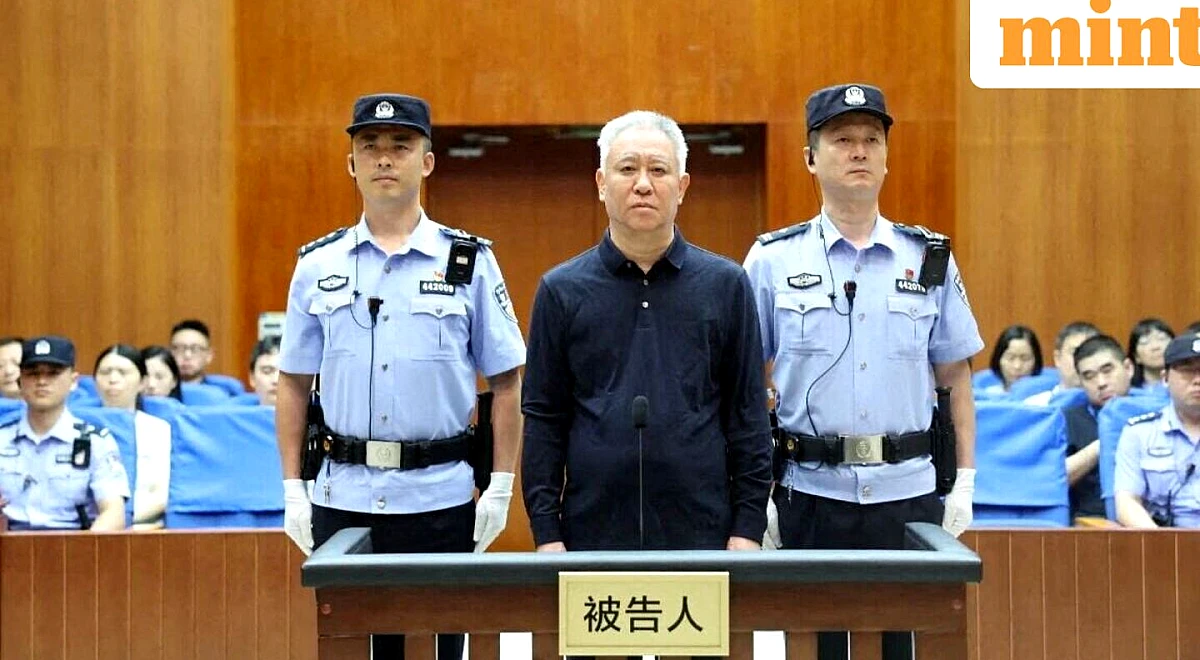
Evergrande founder Xu Jiayin, 67, who was once China’s richest man, was sentenced to life in prison by a Chinese court on Thursday, marking a dramatic fall for the property tycoon, according to AFP.
Xu, also known as Hui Ka Yan in Cantonese, was found guilty of multiple offences, comprising fraud, bribery and embezzlement linked to his management of Evergrande Group, once China’s largest property developer before its 2021 default.
The Shenzhen Intermediate People’s Court has imposed a CNY 8.82 billion (USD 1.31 billion or ₹12,543.50 crore) fine on Xu Jiayin, while Hengda Real Estate, Evergrande Group’s mainland operating arm, was fined CNY 7 billion (around USD 1 billion or ₹9,955.50 crore) ), reported .
State-run Xinhua reported that the penalties rank among the largest corporate fines handed down by a Chinese court in criminal cases.
The court found Xu guilty of multiple offences, including illegally accepting public deposits, fundraising fraud, unlawful lending, fraudulent securities issuance, failure to disclose material information and corporate bribery.
Xu was also convicted of misappropriating funds and embezzlement, while Hengda Real Estate was found guilty of fraudulent securities issuance.
The court ordered authorities to recover the defendants’ illegal proceeds and said any shortfall in recovery would have to be compensated through restitution. Moreover, 56 company personnel, including Xu’s two sons, were handed prison terms ranging from 22 months to 18 years. They were also ordered to pay fines or have their property confiscated.
Xu was born in 1958 into a poor family in rural Henan province, the same year Chinese leader Mao Zedong launched the “Great Leap Forward”, an industrialisation drive that resulted in widespread famine.
His mother died when he was just one year old. Recalling his childhood in a speech, Xu stated his diet during his school years was largely limited to sweet potatoes and steamed bread.
"The sheets I laid, the quilts I covered, and the clothes I wore were all covered with piles of patches," said Xu, adding, “At that time, my greatest wish was to go out of the countryside, find a job and be able to eat better food.”
After completing school in 1976, towards the end of the decade-long Cultural Revolution, Xu struggled to secure employment. He later studied metallurgy after colleges reopened and was assigned to work at a state-owned steel plant.
In 1992, Xu moved to Shenzhen, which had emerged as a major centre of China’s reform and opening-up drive. He subsequently entered the property business and founded Evergrande in 1996.
The company pursued large-scale residential development, constructing apartments across China as the country’s property market and wealth expanded rapidly.
Evergrande went public in Hong Kong in 2009, raising $729 million through its initial public offering. The listing made it China’s largest private property developer at the time and propelled Xu to become the richest man in mainland China.
Xu Jiayin’s wealth peaked at $45.3 billion ( ₹4,33,540.7 crore) in 2017, making him the richest person in Asia at the time, according to Forbes. By 2023, his fortune had plunged to an estimated $3 billion ( ₹28,713.08 crore). The court in Shenzhen on Thursday ordered the confiscation of all his personal assets.
In 2010, Xu acquired the struggling Guangzhou football club and renamed it Guangzhou Evergrande, investing heavily in internationally renowned players and coaches. Despite having little knowledge of football when he took over, Xu oversaw the team’s rise to multiple league titles.
His extravagant lifestyle also drew attention, particularly his fondness for luxury brands such as French fashion house Hermes. He earned the nickname "Belt Xu" after being seen wearing a Hermes belt at the national political congress.
There was also speculation that Xu’s business success was aided by influential connections, including an alleged relationship with the brother of former premier Wen Jiabao.
Xu, however, credited his rise to education and the Communist Party. "Everything of Evergrande is given by the Party, the state and the society," he said.
His lavish lifestyle, including his ownership of yachts, increasingly stood in contrast to President Xi Jinping’s campaign against excessive wealth, as Beijing simultaneously stepped up its scrutiny of corruption in the financial sector.
Evergrande’s fortunes began to deteriorate in 2020 after Beijing introduced measures aimed at curbing excessive borrowing in the property sector, making it increasingly difficult for the company to meet its financial obligations.
The developer was hit by the government’s “three red lines” policy, which imposed limits on three debt-related ratios and pushed Evergrande to sell properties at deepening discounts to raise funds.
As the crisis worsened, the company faced mounting pressure from homebuyers and investors, with its financial troubles sparking rare demonstrations outside Evergrande offices across China.
In an attempt to reassure employees, Xu wrote a letter in September 2021 expressing confidence that the company would "step out of the darkest moment soon".
A month later, Chinese authorities reportedly asked Xu to draw on his personal fortune to help address Evergrande’s mounting debt problems. By December that year, Fitch Ratings had declared Evergrande in default.
Two years later, reports emerged that Xu had been taken into police custody.
A day later, Evergrande disclosed in a filing with the Hong Kong Stock Exchange that Xu was suspected of "illegal crimes", but did not provide further details.
Xu was not publicly seen for almost three years, including during Evergrande’s delisting from the stock exchange in 2025.
His fortune had also fallen sharply. The Bloomberg Billionaires Index estimated Xu’s wealth at $1.8 billion in 2023, a steep decline from $42 billion in 2017.
In April this year, a Shenzhen court mentioned Xu had pleaded guilty and "expressed remorse" over charges including fraud, embezzlement and bribery.
On Thursday, the court handed Xu a life sentence and ordered Evergrande Group and one of its affiliates to pay fines totalling more than $2 billion. The court did not disclose whether Xu made any statement during Thursday’s sentencing.
Garvit Bhirani is a journalist based in Gurugram. He is a Deputy Chief Content Producer at LiveMint, where he covers national and international news stories, focusing on accuracy and compelling storytelling for readers.
With a total of six years of experience in journalism, he has previously worked with Vaco Binary Semantics for Google, taking on the role of news curation lead, and reported from the field on health, education, and agriculture stories for 101reporters and News9. He has also served as a content editor for entertainment and news media organisations.
Garvit holds bachelor’s and master’s degrees in journalism and mass communication from Guru Gobind Singh Indraprastha University and Gurugram University, respectively. During college days, he joined India’s only non-profit student journalism network, where he anchored daily news updates and produced his own weekly show called ‘Data Fix’.
He was selected for the YES Foundation Media for Social Change Fellowship in Delhi, the Talking Data to the Fourth Pillar residential workshop, and the VOICE Fellowship in Pune.
He holds certificates in COVID-19-verification reporting, data journalism, food & agriculture, tech policy, media literacy and countering misinformation, and tackling election disinformation courses from Thomson Foundation, IndiaSpend, The Dialogue, US Mission in India, and AFP.
He can be reached on LinkedIn or on @garvitbhirani on X
Download the Mint app and read premium stories
Log in to our website to save your bookmarks. It'll just take a moment.
Oops! Looks like you have exceeded the limit to bookmark the image. Remove some to bookmark this image.

Comments ()
Be the first to share your perspective on this story!