


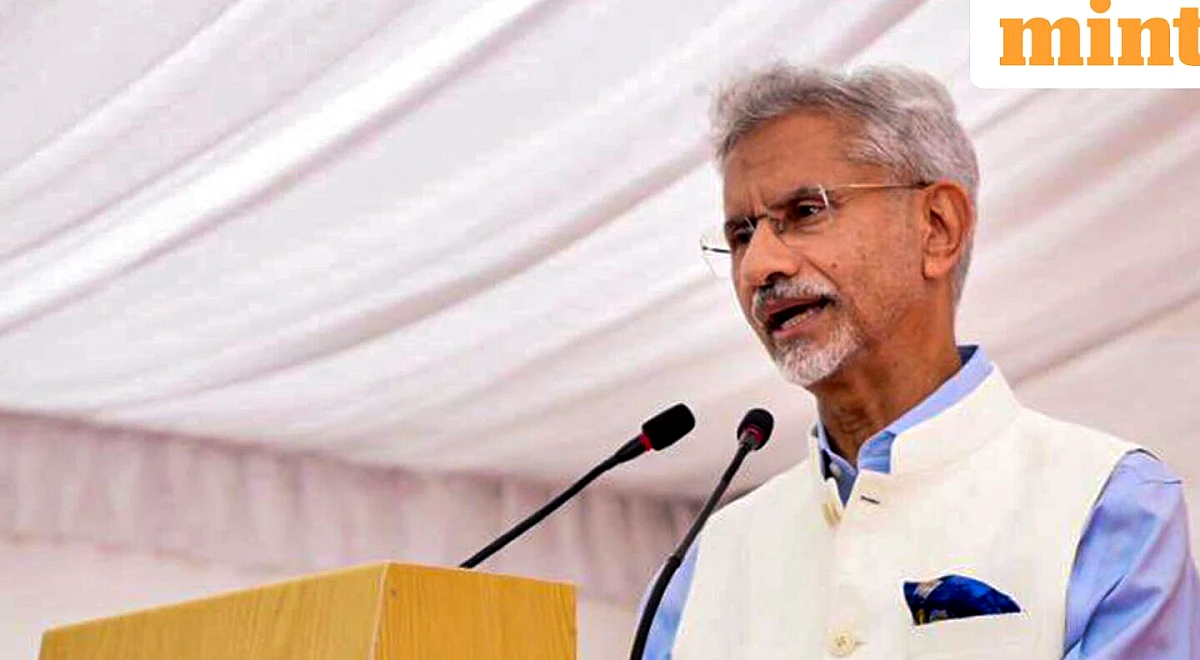
Days after the Ministry of External Affairs (MEA) said that there were no updates regarding Bangladesh Prime Minister Tarique Rahman’s visit to India, External Affairs Minister S Jaishankar on Saturday said that the relationship between New Delhi and Dhaka can work if it meets the “test of mutual interest.”
Jaishankar's remarks came against the backdrop of Bangladesh linking Rahman's possible visit to India to the extradition of former premier Sheikh Hasina, the reported on Sunday.
He made these remarks while participating in a session at the Economic Times World Leaders Forum and said that India does not expect its neighbours to only do what is in New Delhi's interest. He further said that bilateral relations can work smoothly when the two sides find common ground.
Elaborating further, the minister noted that when the two sides find "common ground," the relationship works smoothly and added, "I would say this in respect of all neighbours, that [in] relationships, at the end of the day, there’s a mutuality which underpins that exercise."
Jaishankar, when asked about the Tarique Rahman government's request for Sheikh Hasina's extradition, declined to comment on the discussions between India and Bangladesh regarding the matter. He said, "What I can tell you is for any relationship to work, it has to meet the test of mutual interest. It has to work for them, it has to work for us." He added, "I am also realistic; I’m not expecting neighbours to do only what’s in my interest. There has to be a fair degree, a reasonable degree of my recognising and respecting what is their interest, just as I expect them also to do so.”
India has extended an invitation to Rahman for a bilateral visit as well as to attend the upcoming BRICS Summit in his capacity as chair of the BIMSTEC grouping. However, plans for his visit next week were called off at the last minute, with the two sides now discussing a possible visit later this month or in early September, people familiar with the matter said. Rahman’s visit is seen as important for repairing bilateral ties, which have come under unprecedented strain, with Sheikh Hasina’s presence in India emerging as a major point of contention.
Earlier on Friday, Rahman's press secretary said that Dhaka had not yet made a decision on his visit to New Delhi. His press secretary told , "No decision has yet been made on the visit," and added that the country was waiting for India's response on the extradition of Hasina and "other fugitive criminals".
Rahman’s visit had earlier been dependent on India assuring that Hasina would not be permitted to carry out activities from Indian soil that could potentially destabilise Bangladesh, The Daily Star, a leading English-language newspaper in Bangladesh, reported last week. Earlier reports had indicated that Rahman was expected to visit India on 21 August.
It remains to be seen whether the Rahman-led Bangladesh government will announce new dates for the leader’s India visit.
Swati Gandhi is a digital journalist with over four years of experience, specialising in international and geopolitical issues. Her work focuses on foreign policy, global power shifts, and the political and economic forces shaping international relations, with a particular emphasis on how global developments affect India. She approaches journalism with a strong belief in context-driven reporting, aiming to break down complex global events into clear, accessible narratives for a wide readership.
Previously, Swati has worked at Business Standard, where she covered a range of beats including national affairs, politics, and business. This diverse newsroom experience helped her build a strong grounding in reporting, while also strengthening her ability to work across both breaking news and in-depth explanatory stories. Covering multiple beats early in her career has helped her be informed about her current work, allowing her to connect domestic developments with wider international trends.
At Live Mint, she focuses on international and geopolitical issues through a business and economic lens, examining how global political developments, foreign policy decisions, and power shifts impact markets, industries, and India’s strategic and economic interests.
She holds a Bachelor’s degree in English (Honours) from the University of Delhi and a Master’s degree in Journalism and Mass Communication from Guru Gobind Singh Indraprastha University. Her academic training has shaped her emphasis on precision, analytical rigour, and clarity in writing. Her interests include global political economy and the intersection of geopolitics with business.
Outside work, Swati focuses on exploring her passion and love for food. From fancy cafes to street spots, Swati explores food like a true foodie.
Stay updated with the latest Trending, India, World and US news.
Download the Mint app and read premium stories
Log in to our website to save your bookmarks. It'll just take a moment.
Oops! Looks like you have exceeded the limit to bookmark the image. Remove some to bookmark this image.
Comments ()
Be the first to share your perspective on this story!