

You don’t have any Active Subscription.
Subscribed with another email? Logout and Login with that one.
Account subscription benefits alongside Premium Stories, Editorials, Opinions and more. Unlock these with Subscription
Additional Subscription Benefits
Need help with your subscription?
The View From India Looking at World Affairs from the Indian perspective.
First Day First Show News and reviews from the world of cinema and streaming.
Today's Cache Your download of the top 5 technology stories of the day.
Science For All The weekly newsletter from science writers takes the jargon out of science and puts the fun in!
Data Point Decoding the headlines with facts, figures, and numbers
THEdge At the cutting edge of education and careers
Health Matters Ramya Kannan writes to you on getting to good health, and staying there
Gender Agenda Stories from beyond the binary.
On Books Books of the week, reviews, excerpts, new titles and features.
Published - August 23, 2026 04:24 pm IST - AHMEDABAD
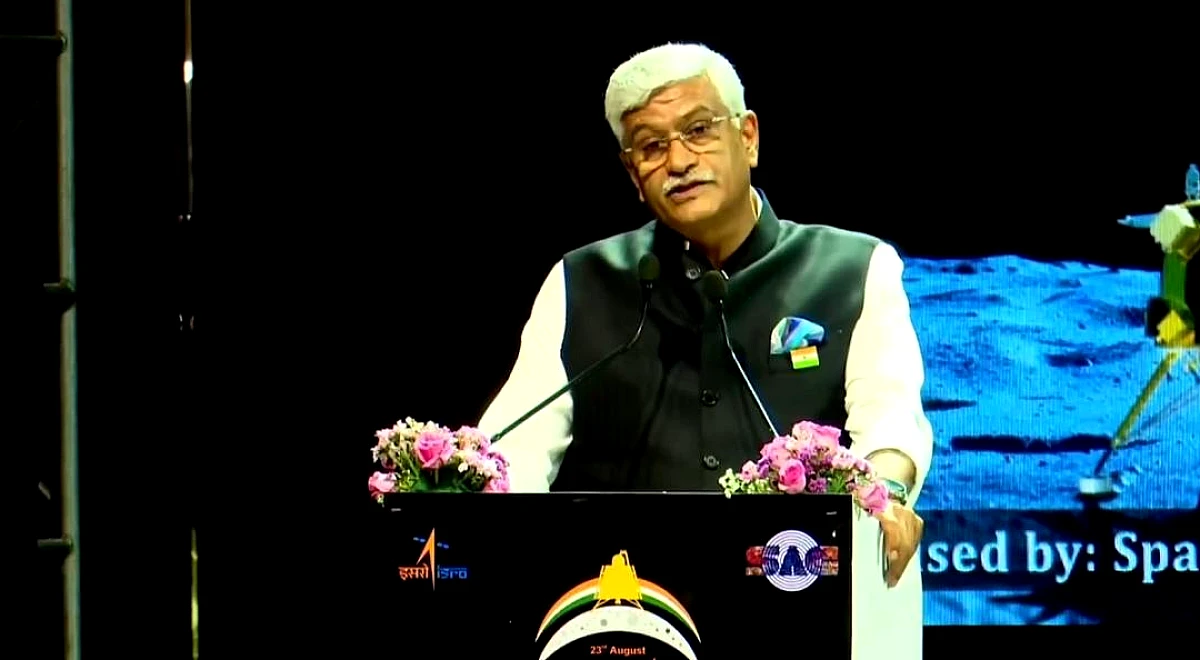
Union Minister Gajendra Singh Shekhawat addresses the National Space Day 2026, on August 23, 2026. | Photo Credit: X/@gssjodhpur
Union Minister Gajendra Singh Shekhawat on Sunday (August 23, 2026) said the convergence of streams like space technology, AI, quantum technologies, robotics, semiconductors and high-performance computing will determine a nation's geopolitical positioning.
Speaking in Ahmedabad on the 3rd National Space Day, the Union Culture and Tourism Minister also said private participation in the space sector does not mean reducing the importance of entities like ISRO.
Privatisation of space is the "democratisation of space opportunities," Mr. Shekhawat asserted at the event, organised by the Space Applications Centre (SAC), Indian Space Research Organisation (ISRO) and the Department of Science.
Today is the age of space technology, artificial intelligence, quantum technologies, robotics, humanoids, advanced materials, semiconductors and high-performance computing, he said, adding that life will certainly be transformed in the coming years.
"Just as science is ultimately integrating in the form of a pyramid, in the coming years, all these technological streams will no longer remain separate. Their convergence will determine the direction of human life, the global economy and geopolitical positioning," Mr. Shekhawat maintained.
"The nation that possesses the power of this convergence will have not only technological leadership in the 21st century, but also economic leadership and the capacity to inspire," he added.
The Minister hailed the visionary leadership of Indian scientist Vikram Sarabhai and his contributions to the field of space and technology.
He noted that privatisation does not mean reducing the importance of entities like ISRO.
Live: National Space Day 2026 https://t.co/jScHcfjWuI
"The day the space sector was opened up to the private sector and startups, IN-SPACe (Indian National Space Promotion and Authorisation Centre) was created as an institutional mechanism for private entities; the way private entities were promoted, enabled, hand-held, authorised and supervised - that day, some people had doubts that although we were moving ahead with the commercialisation of ISRO's technological capabilities, the entry of non-governmental entities might reduce the importance of an institution like ISRO," he said.
Private participation in the space sector never meant reducing the role of established institutions and instruments but multiplying the capacities, opportunities and strength of an institution like ISRO, Mr. Shekhawat said.
Privatisation of space is the "democratisation of space opportunities," he noted.
"With private industry, startups, academia and investors all coming together in this manner, we have now moved beyond the organisation-centric model that we traditionally had in the space sector and entered an ecosystem-centric model," he added.
Mr. Shekhawat also highlighted future challenges in the space sector, including space debris, cybersecurity, data security and the responsible use of artificial intelligence.
Global competition and geopolitical warfare of the future will be based solely on disrupting technological capabilities, he said, adding that keeping all the challenges in mind, India needs to work with determination.
ISRO Chairman V. Narayanan, Gujarat Science and Technology Minister Arjun Modhwadia and IN-SPACe Chairman Dr. Pawan Kumar Goenka were also present at the event.
"August 23, 2023 was a historic day for Indians across the globe as Chandrayaan-3 successfully made a soft landing near the south pole of the moon," Mr. Narayanan said.
He thanked Prime Minister Narendra Modi for celebrating that day as 'National Space Day' to commemorate this historic achievement.
Mr. Narayanan appreciated and acknowledged the efforts behind various achievements of ISRO.
Following reforms in the space sector in 2020, the number of startups in the country has increased significantly, with around 440 startups currently operating in the space sector, he pointed out.
He noted various targets, including Gaganyaan, which is on its final leg; Chandrayaan-4 and Chandrayaan-5; a mission to launch over 300 satellites in 6-7 years with the help of startups and the government; missions to Mars and Venus; and the establishment of an Indian Space Station by 2035.
Published - August 23, 2026 04:24 pm IST
space programme / ISRO
Terms & conditions | Institutional Subscriber
Comments have to be in English, and in full sentences. They cannot be abusive or personal. Please abide by our community guidelines for posting your comments.
We have migrated to a new commenting platform. If you are already a registered user of and logged in, you may continue to engage with our articles. If you do not have an account please register and login to post comments. Users can access their older comments by logging into their accounts on Vuukle.
Comments ()
Be the first to share your perspective on this story!