


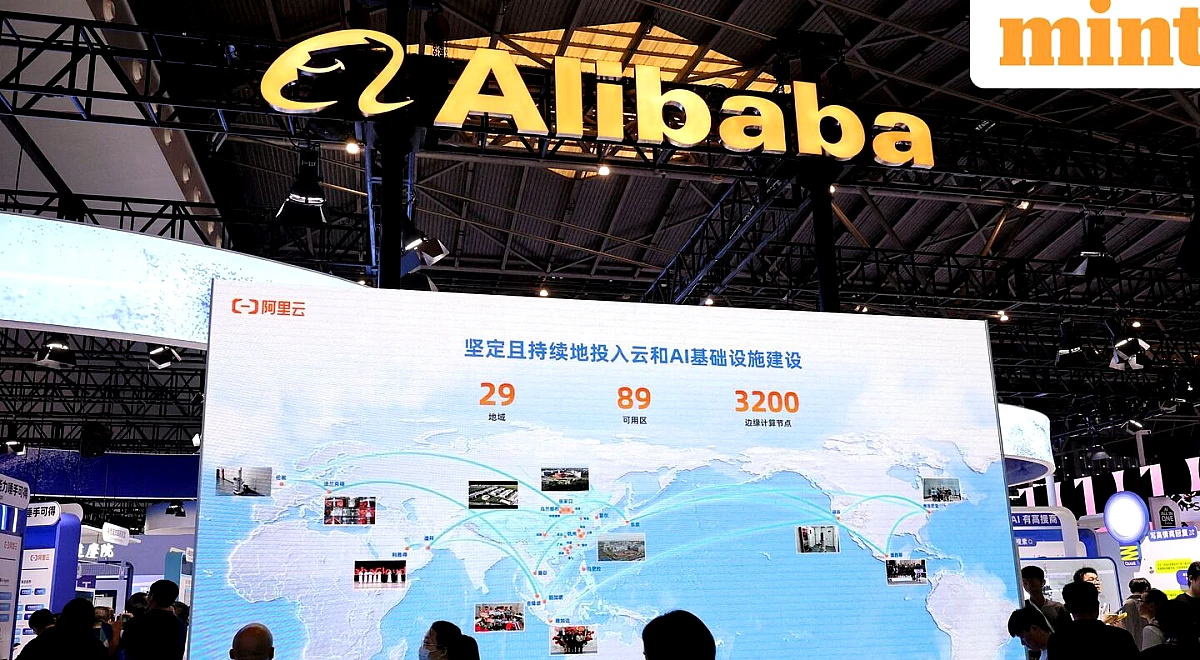
Alibaba Group Holding, on Snday (23 August), reportedly launched a ₹95,000 crore (US$10.2 billion) new share issue in Hong Kong, with the entire proceeds earmarked for expanding its artificial intelligence capabilities. It would rank as the world's third-largest primary follow-on share sale this year after offerings from Alphabet and Intel.
The Chinese technology giant said on Sunday (23 August) that it would issue shares worth HK$80 billion ( ₹95,000 crore; US$10.2 billion) as it seeks to strengthen its position in the global AI race.
Alibaba Group said the funds would be used to “extend the company’s global AI leadership” and “invest in its full-stack AI capabilities”, including expanding and enhancing AI infrastructure.
The placement would be Hong Kong’s biggest follow-on offering by a company on record, according to data compiled by Bloomberg. It would also be the city’s biggest share sale since 2021, when technology-investment firm Prosus NV sold $14.7 billion in shares of China’s Tencent Holdings Ltd., according to data compiled by Bloomberg.
Strong investor interest prompted Alibaba to increase the offering to HK$80 billion, the South China Morning Post reported citing officials in the know.
The deal would be Alibaba's first new share placement since its Hong Kong listing in 2019.
Alibaba plans to sell 710 million shares at HK$112.70 apiece, representing a 3.6 per cent discount to its latest closing price, according to a term sheet reviewed by .
The fundraising comes as Alibaba accelerates investment in AI computing, cloud services, chips and large language models.
Its cloud and AI business recorded a 45 per cent year-on-year increase in revenue in the April-June quarter, while capital expenditure surged 75 per cent to ₹80,000 crore (US$10 billion).
Alibaba chief executive Eddie Wu Yongming said the company expects its investment in AI computing to break even within three years, with the payback period potentially falling to about two years as gross margins improve.
Alibaba had spent ₹2.25 lakh crore (190 billion yuan) in capital expenditure by the end of June. In February 2025, it committed ₹4.5 lakh crore (380 billion yuan; US$56.4 billion) over three years towards AI infrastructure.
Alibaba's AI push extends beyond cloud infrastructure. Its Qwen family of large language models has recorded more than 3 billion downloads globally, while its T-Head semiconductor unit is expanding its AI chip business.
Alibaba's Zhenwu chips have served more than 650 customers on Alibaba Cloud. Its Zhenwu M890 AI processor also entered commercial-scale deployment earlier this month.
The company's AI Cloud and Compute Services segment generated ₹57,000 crore (48.4 billion yuan) in revenue for the quarter ended June 30, marking its fastest growth in 22 quarters.
“We expect supply to continue ramping up in the second half of the year to meet strong customer demand,” Wu said.
The massive fundraising comes after Alibaba's quarterly net profit plunged 75 per cent year on year as AI-related spending increased. Its revenue, however, rose 9 per cent to nearly ₹2.24 lakh crore (269 billion yuan).
Alibaba's New York-listed shares fell 8.57 per cent on Friday, while its Hong Kong-listed shares declined 2.54 per cent.
Alibaba Group is now joining a global race for AI capital. Tencent Holdings' AI capital expenditure rose 176 per cent year on year to ₹62,000 crore (52.8 billion yuan) in the June quarter.
US technology companies are spending on a far larger scale. Amazon, Microsoft, Alphabet and Meta are collectively expected to spend about ₹62 lakh crore (US$700 billion) on capital expenditure this year.
Sayantani Biswas is an assistant editor at Livemint with seven years of experience covering geopolitics, foreign policy, international relations and global power dynamics. She reports on Indian and international politics, including elections worldwide, and specialises in historically grounded analysis of contemporary conflicts and state decisions. She joined Mint in 2021, after covering politics at publications including The Telegraph.
She holds an MPhil in Comparative Literature from Jadavpur University (2019), with a specialisation in postcolonial Latin American literature. Her research examined economic nationalism through Eduardo Galeano’s Open Veins of Latin America. She also writes on political language, cultural memory and the long shadows of conflict.
Biswas grew up in Durgapur, an industrial town in West Bengal shaped by migration, which drew families from across India to the Durgapur Steel Plant. As the only child in a joint family, she spent years listening—almost obsessively—to her grandparents’ testimonies of struggle, fear and loss as they fled Bangladesh during the Partition of 1947. This formative exposure to lived historical memory later converged with her training in Comparative Literature, equipping her to analyse socio-economic structures and their reverberations.
Outside the newsroom, she gravitates towards cultural history and critical theory, returning often to texts such as Paulo Freire’s Pedagogy of the Oppressed. As a journalist, she is committed to accuracy, intellectual rigour and fairness, and believes political reporting demands not only clarity and speed, but historical depth, contextual precision, and a disciplined resistance to spectacle.
Download the Mint app and read premium stories
Log in to our website to save your bookmarks. It'll just take a moment.
Oops! Looks like you have exceeded the limit to bookmark the image. Remove some to bookmark this image.


Comments ()
Be the first to share your perspective on this story!